





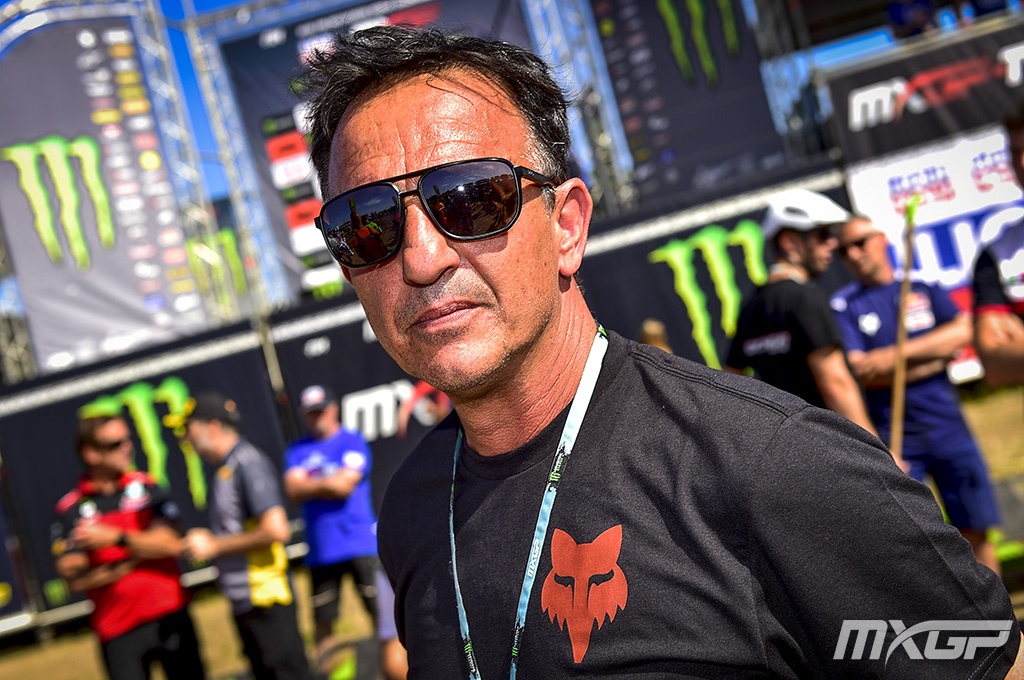
Few people are better placed to compare the American and European motocross scenes than Fred Vialle. A former Grand Prix winner himself, Vialle has also played a key role throughout the career of his son, Tom Vialle, who achieved success on both sides of the Atlantic by winning MX2 world titles before becoming a two-time AMA Supercross champion.
Speaking at the German Grand Prix, Fred discussed Tom’s injury setback following the French GP, the decision to return to Europe with Honda HRC, the realities of life and racing in America, and his thoughts on the current state of MXGP. He also offered an interesting perspective on rider development, marketing, and why he believes the sport still has room to evolve despite its increasing professionalism. Kevin Frelaud with the interview.
Frederic, first of all, how is Tom after his crash in France? He’s not racing this Sunday in Germany.
Vialle: He had a pretty serious crash in France. We spent the week without riding. We discovered he had a fractured rib. Tom tried, but it was really difficult. We came here with a small hope, but it wasn’t possible. The muscles in his back are completely locked up.
It’s nothing dramatic, but it’s better to take our time. The championship is still long, and we’ll be able to gain experience and prepare as well as possible for next year.
There were a few incidents in France: one in the first moto involving Thibault’s crash, and another involving Tom in the second moto, after which he wasn’t allowed to restart. Romain spoke publicly about it after Lacapelle. What did you think of his comments and the handling of those incidents?
Vialle: I’m happy that top riders can speak freely and give their opinions. Unfortunately, with Thibault’s crash, there are question marks and explanations that I think the FIM should provide. Personally, I believe they could have shown a red flag. It wouldn’t have been crazy to do so on the first lap. In that regard, there was a failure.
At the start of the second moto there was a red flag. Apparently they considered there were riders scattered all over the track. But during the third start, riders crashed in a very similar way and there was no red flag. That’s surprising because perhaps it should have been stopped as well. I think there may be other constraints involved beyond simply checking whether everyone is okay.
Tom won two titles in three years in the USA. What did the American experience give him that he wouldn’t have gained had he stayed in Europe?
Vialle: Extra experience, and a different approach to racing. Over there, everything is completely different. In Europe we’re much more supported, whereas in the USA you’re on your own. The organisation is very different.
First of all, it teaches you to mature. Secondly, the goal was to continue racing in the 250 class. It also helped him develop more aggression. Riders in America have a level of aggression that you don’t really find in Europe. The tracks contribute to that as well. The circuits are completely different, which allows riders to evolve differently. We’re talking about Tom, but look at Farres after returning from America. He’s very aggressive in the opening laps and manages races well. He also took a step forward.
You’ve experienced both sides of the Atlantic as a rider and through your son. I’m curious about your opinion regarding the scale of the championships. Is MXGP as professional, structured and well-promoted as AMA racing?
Vialle: If we’re talking strictly about Motocross, then yes. The World Championship is much more publicised and much more developed. In Europe, MXGP is essentially what Supercross is in the United States. That’s normal because motocross is the number one discipline here.
Of course there are still shortcomings. I think there is still a need to evolve. MXGP has reached a very high organisational level, but there still isn’t enough dialogue between the promoter, the FIM and the riders. That’s where I feel things are lacking. Nothing has really evolved in that area. It’s a shame because motocross is a complex sport and there is a lot of money involved, whether invested in teams or riders, yet some rules still feel amateurish.
There were rumours during the off-season. What led to Tom returning to Europe and moving into MXGP rather than stepping up to the 450 class in America?
Vialle: It’s simple. We were in discussions with KTM and Tom wanted a longer contract than what was offered. He was moving up a class and you have to be realistic. If the first season is difficult and your contract ends, you can be left with nothing. For us it was all or nothing, and we didn’t want to take that risk. You can’t gamble your entire career like that, especially in the United States.
At the same time, we had an excellent offer from Honda through Giacomo Gariboldi. It was a multi-year deal, with a good bike and a strong project. The decision was easy. Things were very good at KTM, but let’s just say there were certain people who didn’t really want us to stay.
You signed with Honda without testing the bike. How did that happen?
Vialle: No, we didn’t test it. You already know a Honda works. Unless you’re signing with a completely new manufacturer or riding a totally new bike, testing isn’t absolutely necessary.
We’re talking about Honda HRC. That’s not just any team. Tom had offers from other American teams as well. But we’d have been talking about racing 450 Supercross, changing brands and changing bikes. It was complicated. We preferred to make that transition in Europe.
Do you feel that the World Championship offers enough opportunities today to compete with the attraction of the United States? Many young riders dream of ending up in America, while the opposite seems much less common.
Vialle: I think it does. In my opinion, it’s mainly a media issue. I like using the example of Haiden Deegan’s father. He explained that MMA has grown enormously compared to Supercross. Ten years ago MMA had much less exposure, whereas now it’s huge.
The Deegans understand this perfectly. Motocross needs to be made more attractive. People enjoy conflict and drama, especially in America. They know exactly how to create that. Just look at Haiden’s social media following. In Europe we’re missing some of that. We’re perhaps a little too neutral.
You’ve spent time around Haiden Deegan. Is he arrogant, wild image genuine or is he playing a role?
Vialle: He’s playing a role. It’s a game. In real life, the Deegans may be outgoing, but nothing excessive. Professionally, though, everything is exaggerated. That’s their job.
They’re professionals at that. I adapted things from what I used to do in Grand Prix racing, and Brian Deegan was always one step ahead of me. He leaves nothing to chance.
People shouldn’t think it’s all bling and arrogance. That’s just the cover. That said, Haiden has also had a fantastic bike in America. In the 450 class things might be a little harder, but he’ll still be there.
Tom returned to Europe, moved up to a 450, entered MXGP and changed brands all at once. Does his ability to adapt surprise you?
Vialle: Yes and no. When you come back from America, you’re already carrying positive momentum. During the first Grands Prix I was surprised, but not completely surprised.
Of course you’re delighted with those results, but you also keep some perspective. Early-season results can be misleading. Considering his limited experience with the bike, the capacity, and the riders he was facing, we knew consistency would be difficult. We were happy, but we constantly question ourselves and keep looking for ways to improve.
Is today’s MXGP World Championship comparable to the one you raced in 30 years ago? Has it moved in the right direction?
Vialle: Honestly, no. It’s impossible to compare. Thirty years ago is a long time ago. But even compared to ten years ago, there have been many changes. The biggest issue is that riders are getting faster and faster. The level is incredibly high now.
That’s one reason why you see such big differences in lap times and race performances. The problem is that we’re often racing on the same tracks as decades ago. They get rougher than before, similar to America, but the circuits are naturally slower and overtaking is difficult. Riders end up taking bigger risks.
Financial investment, team structures and media coverage have all improved enormously. That’s positive. But there are still things that need reviewing.
When you look at the power of a modern 450cc, you can’t keep using the same start straights from fifteen years ago. Riders arrive at the first corner twice as fast. In America, if there’s an issue with a jump or a corner, AMA officials come and ask the riders. They gather feedback and act if the same concerns keep coming up. That’s a real advantage.
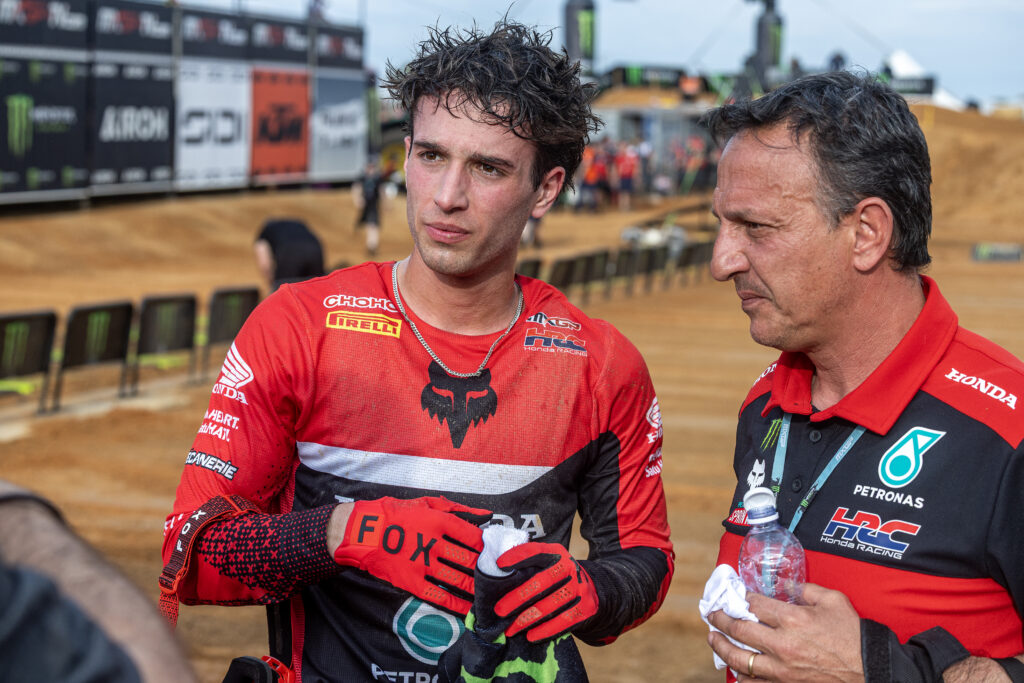
Do you think Tom truly lived the American dream?
Vialle: Yes, because it was something incredible. What Tom achieved in the United States impressed me enormously. Winning two consecutive AMA Supercross titles without previous Supercross experience is crazy. However, life wasn’t easy.
Honestly, I didn’t expect daily life, team life and everything surrounding it to be so difficult. You’re not at home there, and they make sure you understand that. You avoid expressing too many opinions and you can’t think entirely like a European. You have to become American, whether you want to or not.
I look at Ken Roczen and Marvin Musquin and I think they adapted very well. I’m not sure Dylan Ferrandis necessarily enjoys it as much, despite having had a fantastic career. For us it was a dream and we were happy, but I wouldn’t call it the ultimate fulfilment.
Did you feel any hostility from American fans considering Tom was racing against their riders and especially against Haiden Deegan?
Vialle: It’s very simple. There was never any problem between Tom and Haiden. Do you know why Because Haiden was beating him. The Americans loved seeing their rider ahead of a two-time world champion. It’s the same with Jorge Prado. Right now they love having him there because he’s not winning. But once he starts winning, he’ll start bothering people.
When Tom wasn’t winning, they were happy to have him too. What surprised me was that after winning his second Supercross title, they introduced him as a two-time world champion, not as a two-time American champion.
Which current MXGP rider do you think has the best chance of succeeding in America?
Vialle: For me, Lucas Coenen. Sacha Coenen as well, although I’m a bit more concerned because of his size when it comes to Supercross. The whoops won’t be easy. Right now, the Coenen brothers are the only riders I can clearly see succeeding there.
Does a rider need to be as much a marketing product as a successful athlete nowadays?
Vialle: It’s the number one tool in every sport. It’s definitely better to be a strong marketing product. That’s what Haiden Deegan has understood.
Team managers look at riders’ social media accounts. That’s quite dramatic, but it’s the reality. If Haiden Deegan came to Europe, I don’t think other riders would know what hit them. Media attention would be focused on him 200 percent and nobody would talk about anyone else.
By returning to MXGP, aren’t you giving up some of that marketing value and media exposure?
Vialle: I actually think MXGP is pretty good in that regard. People only hear about what Jett Lawrence or Chase Sexton earn. I’d like to know what someone like Justin Cooper earns while finishing fourth in the Supercross championship. If you compare the top four riders in America and the top four in MXGP, I don’t think the differences are as big as people imagine. And don’t forget everything is paid in dollars while the cost of living in the USA is extremely high.
At any point did Tom’s career take priority over family life? Was it difficult to separate the sporting side from the family side?
Vialle: No. On race day, I simply try to bring something positive to him. We’ve always approached the sport with simplicity and without regrets. Whether Tom succeeds or not doesn’t change anything.
There is a life outside motocross and many people forget that. In America, sport is deeply embedded in education and seen as a measure of success. The pressure is enormous, much greater than in Europe. The bike is not the ultimate goal. There is much more to life than that. You also have to build something for life after racing.
The whole family moved to America. Didn’t that put extra pressure on Tom?
Vialle: Not at all. We were organised, and KTM helped us organise everything properly. Tom handles his own responsibilities and the rest of the family handles theirs.
Life goes on regardless. This wasn’t some reckless leap into the unknown. It was all carefully planned.
You seemed unsurprised by Jorge Prado’s difficult first season in America. Why?
Vialle: Jorge already knew the 450cc class and he’s a fantastic rider. But he changed manufacturers and joined a brand he didn’t know, one that already seemed to have some difficulties.
On top of that, he’d never ridden Supercross before. That’s a huge challenge. We actually used Prado’s situation as an example when discussing potential American offers for Tom in 2026. The obstacles would have been enormous. It’s also much harder to go from MXGP to America than it is to come from America back to MXGP. There’s a huge difference.
What makes you most proud of Tom’s career?
Vialle: His first MX2 world title and then the two Supercross titles. People need to understand what he actually achieved. The question isn’t whether someone could do better. The question is: how did he do it? People don’t realise what those first Supercross training sessions were like, or what his first year in America involved.
There were lots of crashes and a steep learning curve. During his first season, he made every Supercross main event. People think that’s normal, but it’s not. His American teammate didn’t even make every main event. In his very first Supercross race, he should have been on the podium but lost his rear brake near the end. Credit to him.
Tom is organised, focused and motivated like every top rider. What makes him different is that he has always remained very simple and grounded. Some riders think they’ve already achieved everything. Tom never arrived in America believing he would dominate. Keeping your feet on the ground is important, and it’s not a weakness.
Finally, you spent many years with the Austrian group and now you’re part of a Japanese manufacturer. Does that change the way of working?
Vialle: Yes and no. Honda definitely has its own Japanese approach, which is heavily focused on performance. They work extensively on motorcycle development, and that ultimately benefits customers as well. KTM does that too, but the philosophy is different. Honda is focused on performance while simultaneously developing future motorcycles. That’s why I believe Honda’s MXGP programme is more advanced than its American programme.
In MXGP they can develop prototype machines and use that work to shape future production bikes. They can’t do that in America. I think that’s one of the limitations of the American motocross championship. Manufacturers can’t develop motorcycles as freely there, and that’s something we experienced during our time with KTM. The American market is extremely important because it generates huge sales, but it doesn’t necessarily allow manufacturers to develop future technology in the same way as MXGP does.