








How can MXGP become more commercially attractive? It’s a simple question on the surface, but one that actually touches on one of the deepest challenges facing the championship today. Article by Kevin Frelaud.
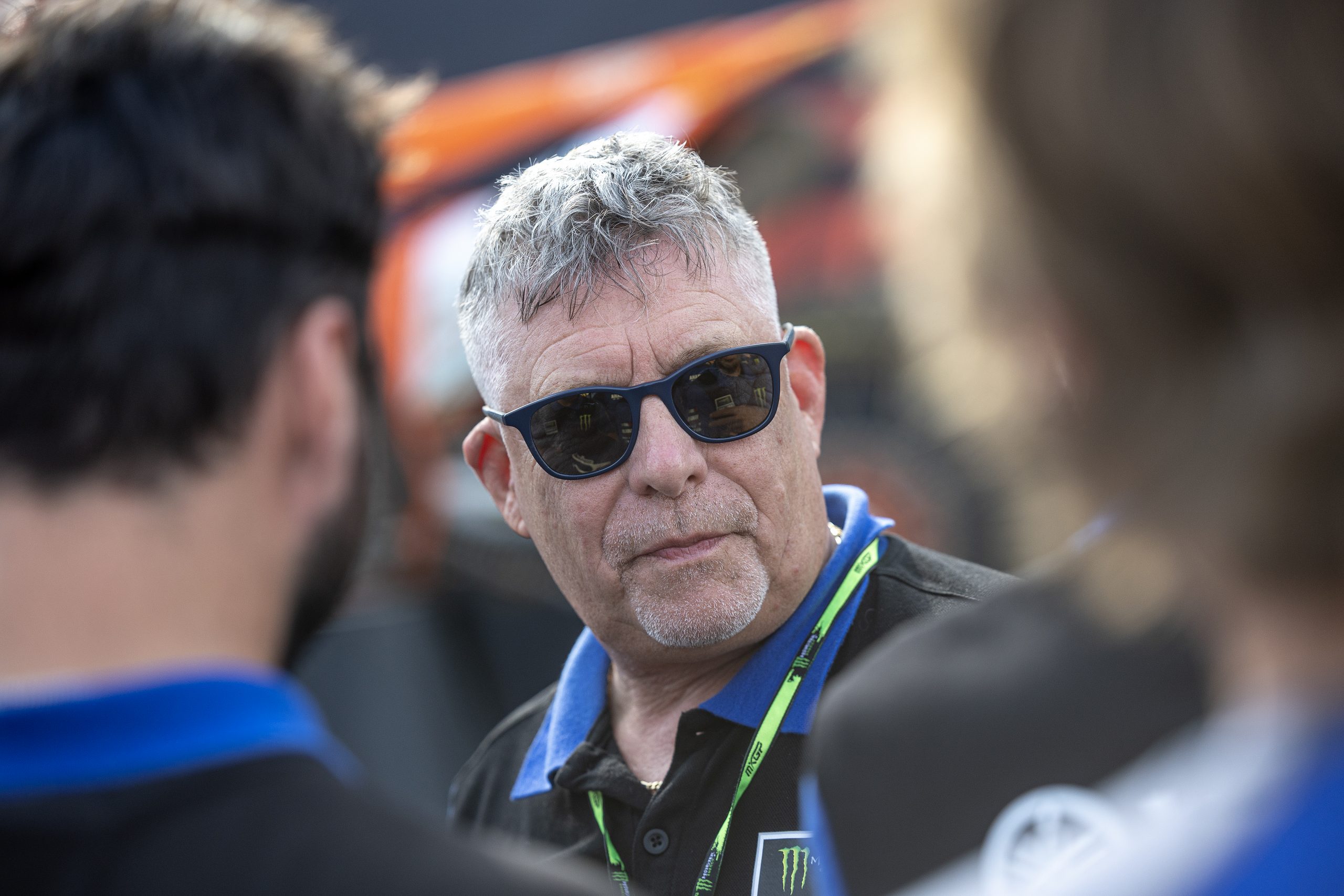
Asked about the topic during the Grand Prix of Trentino, Hans Corvers — owner of the official Yamaha MXGP team — shares a perspective shaped by three decades of experience. Caught between nostalgia for a time when Motocross had a stronger presence on television and today’s economic reality, Corvers highlights a model that is overly dependent on teams themselves to exist in the media. Beyond funding his own structure, he also operates behind the scenes — without him, Motocross coverage in Belgium would be significantly limited.
“It’s a difficult topic, but I can tell you that in Belgium — speaking about my country — the sport used to be on TV all the time back in the days of Stefan Everts and Joël Smets. After those riders, it disappeared. We need to bring the sport back on TV. For the past six years, I’ve been paying for Telenet Play Sports to broadcast MX2 and MXGP in Belgium, and that’s not how it should work. In return, we get advertising slots that we resell to cover the costs. That’s how things work right now, and why we’re so busy — but it’s not the right way to do it. Infront does a lot to bring the sport to different countries, but I believe it’s their responsibility, not ours, to make it available live in every country on bigger channels. As things stand, broadcasting has to be funded by sponsors. Because Motocross is attractive. When Play Sports runs surveys with their viewers, they say Motocross is the biggest of the smaller sports. It’s a niche.”
To make MXGP more attractive — and less expensive for its stakeholders — Corvers also points to a key area for change: the event format itself. In his view, the championship would benefit from a clearer, more efficient structure by focusing everything into a single day. A more compact format, far removed from MotoGP or Formula 1 standards, which Motocross neither needs nor should try to imitate. The goal: simplify a structure he sees as too heavy, too costly, and increasingly hard to justify.
“To make it more attractive, I personally think everything should be organized into a one-day format. For us, the weekend already starts on Friday with start practice, then the full schedule on Saturday and Sunday. It’s long, it’s a lot, and it costs a lot of money. We need to understand that MXGP is not MotoGP or Formula 1. We don’t need to start on Thursday or Friday like them. Because we’re not them, we don’t have to copy them. A one-day format would be ideal. Bring everything together, make it more compact. For young riders and European riders, let’s do everything on Saturday. They’re young, they need to be in school. Right now, they already miss Friday because they have to be there early on Saturday, and they race on Sunday too — so they’re likely to miss school on Monday as well.”
For Hans Corvers, the conclusion is clear: if MXGP wants to grow in popularity, the momentum has to come from the top. The roadmap must also make the championship more appealing to media, fans, and broadcasters. Still, he acknowledges the work done by Infront Moto Racing, which has already brought significant progress to the sport. But at the same time, he points to a system that has become too heavy and too expensive for teams to sustain.
“To make the sport more popular, the push has to come from the organizers — the FIM and Infront. They need to do the work to make it more attractive for the media, for the public, on TV. That said, I have to recognize that Infront is doing a great job. They do their best and have already achieved a lot for our sport. The Luongo’s know how it works and they do a good job. We need to acknowledge that and stay positive. But overall, it’s too heavy and too expensive for me. We can’t even compare Motocross to Formula 1 or MotoGP. I’m sorry to say it, but today there are only seven or eight team owners. If we stop paying the bills, there is no World Championship as we know it. That’s a very, very important point. They know it at Infront — I know they do — but they also need to understand that this can’t go on like this much longer. We can’t grow the sport in its current state, because that would mean spending even more money, and you need a lot of passion — and maybe be a bit crazy — to do what we do. Because it costs a huge amount of money.”

The equation is simple: without team owners’ investments, MXGP would look very different. But that dynamic comes at a cost — one that is becoming increasingly difficult to sustain without external support. For Corvers, the solution lies beyond the traditional boundaries of the sport — even beyond Europe. The objective is clear: attract a major external player capable of leveraging MXGP’s marketing potential.
“If team owners like us weren’t here, manufacturers would still have programs, yes — but with only one factory rider. Thanks to us, Yamaha now has four. That’s the reality. We need help — teams need help. Right now, as we speak, I’m paying two people to search worldwide for a multinational to invest in our team. It could be any company. We just need to find one, and we’re no longer looking only in Europe. I told them to search everywhere. For some companies in the Middle East, two million is nothing — but that’s exactly what we need. Kemea has been around for 30 years this season. I have a lot of small sponsors, and every year a few more come in. They reach out wanting to join the journey — and I’m very thankful for that. But with €10,000 or €20,000, it doesn’t work for us — it’s not viable. Still, we’re happy they’re interested, because it shows the sport is attractive. But every team should have one major sponsor from outside Motocross investing in them.”
Beyond the diagnosis, Corvers still believes in MXGP’s potential to attract major global brands — provided the approach is better structured. The idea is to build bridges between the paddock and multinational companies, making it easier for them to enter the sport. In that sense, the recent arrival of Petronas alongside Honda is seen as a positive signal.
“I believe there can be a return on investment. I don’t want to name specific companies, but take Gillette or Panasonic, for example. If they have any interest in Motocross, we should be able to organize a roundtable with Infront to help them enter the sport. Infront needs to help us attract these kinds of brands. And we also need to give them visibility in return. I really hope we can bring in big companies — and of course, I need to discuss this with Mr. Luongo. Petronas coming in is a good signal. We are looking for multinationals. I don’t know the exact figures, but if Petronas is investing around two million, that’s peanuts for a company like that — but for a team owner, it’s huge. If this happens more often, it will help the sport. Maybe we’ll find one ourselves. But I’ve said it many times internally: Yamaha is a big brand, Honda is a big brand, KTM is a big brand — we’re all big brands. So I don’t understand why we can’t attract multinationals to support us in Motocross. Energy drinks have been here for years, thankfully. But now we need to bring in new investors from outside the sport.”
In the end, Corvers brings the discussion back to a simple reality: attracting new partners will require a collective effort to turn interest into real commitment. A challenge he acknowledges as particularly complex in today’s environment. Because at its core, Motocross remains what it has always been — a niche sport, unique and difficult to mainstream. But for Corvers, embracing that identity doesn’t mean giving up on growth — quite the opposite.
“We need to find these companies and convince them to work with us. I’m sure it’s possible, but it will take a big effort from everyone to show them it’s worth it. When we ask Infront for data so sponsors can do their analysis, they provide it — and we’re thankful for that. But finding these companies is not easy, it’s very difficult. Motocross was, is, and will remain a niche sport. You either like it or you don’t — there’s no middle ground. It’s a special sport. There’s no asphalt, there’s mud in the paddock, the weather can be bad — you won’t see people walking around in high heels at a Motocross track. As the Play Sports director once told me: ‘Hans, Motocross is the biggest of the smaller sports.’ And we have to accept that — but it doesn’t mean we can’t improve it.”