
Between injuries, career choices and missed opportunities, being a highly rated prospect is not always enough to establish yourself in the MXGP paddock long-term. In this interview with Kevin Frelaud, Tom Guyon speaks openly about his career, the opportunities he believes he missed and the reasons that gradually distanced him from the World Championship. With experience and perspective, Tom shares his view of the sport and outlines his new ambitions.
Tom, in the past you won a handful of French Championship titles. You were runner-up in the EMX125 and the 125cc World Championship. At one point, you were the rising French star. The years have passed. You told me that a lot of people ask you why you don’t try your luck in the World Championship again. What is the answer, once and for all?
Guyon: Yes, when I was younger, I started winning very early. I had several years of good results in a row. Then I moved up to the 250cc class in the European Championship. For me, the switch to four-stroke bikes was the biggest turning point. I started crashing. I was riding fast, but I kept falling, and naturally, I ended up getting injured several times.
The injuries kept coming, and that is what gradually pushed me away from the Grand Prix’s. When I was younger, my goal was to ride for the biggest teams in the World Championship. Unfortunately, it didn’t work out that way.
But I am happy with what I am doing today. Just because I no longer race Grand Prix’s doesn’t mean I can’t ride a bike. The GP paddock wasn’t the only end goal, and there are still opportunities to make a living from my sport and my passion.
I’ve turned the page now, although it was a little difficult at first to accept that I hadn’t succeeded. But when you open your eyes, you realise there are other opportunities, starting with Supercross, which is a discipline I really enjoy. There is also the CFS, races in Brazil, Australia, India and so on.
Rossi, Prugnières, Guyon. Different journeys, different situations. But all three of you represented the next generation in your own way at one point. For various reasons, you’ve all moved away from the World Championship. What separates the riders who make it from those who have to accept that they won’t? Sometimes, it feels like you just need to be in the right place at the right time, or have a little bit of luck.
Guyon: You always need a bit of luck. But you also have to know how to create your own opportunities.
Marc-Antoine was an incredible talent. Technically, that guy was going to blow everyone away. He suffered several serious injuries and moved away from the sport. Prugnières, I would say, was a little less talented, but he was still very fast. Quentin, Marc-Antoine and I were all capable of racing GPs. But not everyone can make it to the top. It’s like a funnel: the further up you go, the narrower it gets. We missed our chance, that’s how it is, and you have to accept it.
I’ve accepted it. To stay in the GP paddock, you need to get into a good team straight away and deliver results. Looking back, racing the World Championship with a team that isn’t up to the job or a bike that isn’t competitive is a recipe for failure.
In 2022, I was still with VRT. I had an excellent bike. I was able to produce some great performances and had good speed. But that was because I had a very good bike. Without that kind of machinery, you simply cannot run at the front, not a chance. We saw that very clearly the following year with Fantic: it was a chaotic season for me.
In 2019, you finished runner-up in both the European and World Championships. On paper, you finished ahead of De Wolf, Langenfelder and Farres. Three riders who later became MX2 World Champions. Things don’t always work out the same way for everyone, do they?
Guyon: Yes. But Kay de Wolf was very young when he moved up to the 125cc class, whereas I was in my final year. I was going for the title. In fact, given his age, I should have been finishing ahead of him. He must have been around 14 at the time. Langenfelder followed a similar path.
As for Guillem Farres… I don’t know how he managed to secure a deal with Star Racing. Especially because he hadn’t produced any exceptional results when he went over there. Guillem certainly had a beautiful riding style, but honestly, I don’t know how he managed to get a contract with them. In any case, he has lived up to his role since then: he became World Champion. All three of them did.
I think the difference comes down to certain career choices, how you go about things, how you train, who you surround yourself with and the support you receive. The people around you play a huge role. I experienced that myself. If you have the right people supporting you and the right approach, you’re already in a good position.
When you get injured, you have to take the time to recover properly. You cannot rush back, otherwise you burn yourself out, and then it’s over. I realised that I wasn’t always surrounded by the right people. I learned a lot from that afterwards. Sport is a great school for life, and I have no regrets.
I know I won’t have a career at World Championship level. That’s not a big deal; you have to know when to move on.
In 2021 and 2022, you were racing in the EMX250 Championship. You were capable of finishing in the top five and fighting for podiums. Those were pivotal years. We can see that only two or three riders come out of the European Championship with good rides in MX2. Injuries didn’t help you during those years. Do you think that’s when you missed your opportunity?
Guyon: Maybe I didn’t arrive at the right time, I don’t know. The doors didn’t open for me then. You can’t always explain why a career unfolds the way it does. Sometimes a rider comes along, the opportunity falls into place, and it works out for them. Sometimes it doesn’t.
The truth is that I never had a major opportunity. Perhaps I simply didn’t deserve one. There were riders who were better than me. We all wanted to ride for the factory teams: KTM, Yamaha and Kawasaki. I never had the opportunity because my results weren’t good enough to earn one.
That’s part of the game and part of sport. Sometimes there are more opportunities, sometimes fewer. You also have to admit that some riders deserve them more than others.
In 2021, you only contested four rounds of EMX250 because of injuries. You finished fourth three times, ahead of riders such as Everts, Oliver, Farres, McLellan and Horgmo. Those are guys who subsequently received opportunities that you didn’t get. The speed was there, but consistency let you down. From a team’s perspective, taking a chance on you was risky.
Guyon: Yes. I had this reputation as a rider who was fast but crashed and got injured. That’s when I realised how much the people around you matter.
When I was younger, I always wanted to do more, more and more, sometimes too much. I was never someone who was lazy. I was constantly overtraining, and above all, I was very fragile. Whenever I crashed, I broke something.
As the years passed, I learned from all of that. I discovered what suited me, what I enjoyed and what worked for me. I learned a lot. Today, I manage everything myself and organise my own training schedules. I know what I need and have adapted everything accordingly. Over the years, I gradually recognised the mistakes I’d made. But when you’re younger and lack experience and perspective, you charge ahead without really knowing what’s beneficial for you.
In 2022, you scored that famous MX2 World Championship podium in France. The following year, you signed with Maddii Fantic. On paper, it was an official team, and it looked like a great stepping stone. But nothing went according to plan there…
Guyon: When I went to test the bikes before signing, they worked really well. They had everything they needed, including the engineers and so on. I was coming off the KTM at VRT, which was excellent.
The Fantic wasn’t far off my KTM. It was a very good bike. When I tested it at Lommel, I thought there was potential to do something in the World Championship with it, provided we could find a little more power. It wasn’t unreasonable to think we could run at the front in GPs.
I signed, arrived in Italy, and never saw the bike I’d been given to test again… I told myself I would just have to make the best of it. During testing, I was going through as many as four engines a week. At one point, they told me to sort it out myself and gave me a standard engine, basically saying, “Stop bothering us.” I was there with them in Italy, far away from everything, and things weren’t going well.
It was genuinely one of the worst years of my life on every level: mentally, physically and in terms of my mindset. It was extremely difficult. I injured my shoulder in Argentina after another rider landed on me at the very first GP. I came back later and injured my knee. That was how my season ended…
After that, you spent 2024 racing in France with Valentin Teillet before securing an opportunity with Riley Kawasaki for 2025. It was supposed to be your final year in MX2. The project was led by Olaf Hazen, a familiar name in the paddock… But everything fell apart before the season started. You must have felt as though you’d been robbed of your final World Championship season, didn’t you?
Guyon: Absolutely. When I was told I could return to the GPs with interesting equipment, people we knew and who were competent, and good engines, I thought it made perfect sense. But I was completely led on.
I never saw any of the things I’d been promised, and I had to leave the World Championship without ever getting to do my final GP season. That’s when I realised it was over for me, and I decided to turn the page on the World Championship. At first, it was difficult to accept, naturally. But I decided to bounce back. I needed something new.
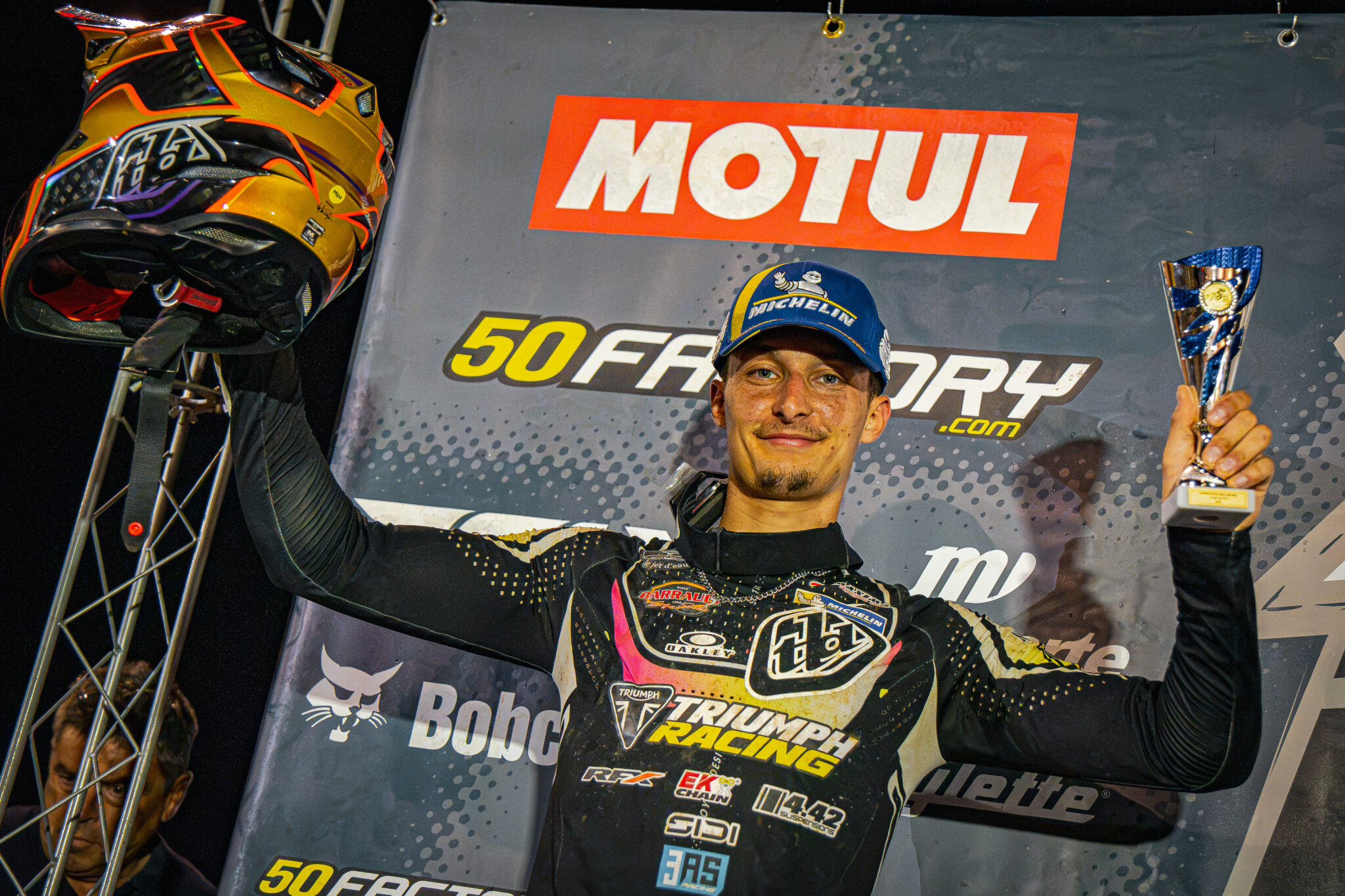
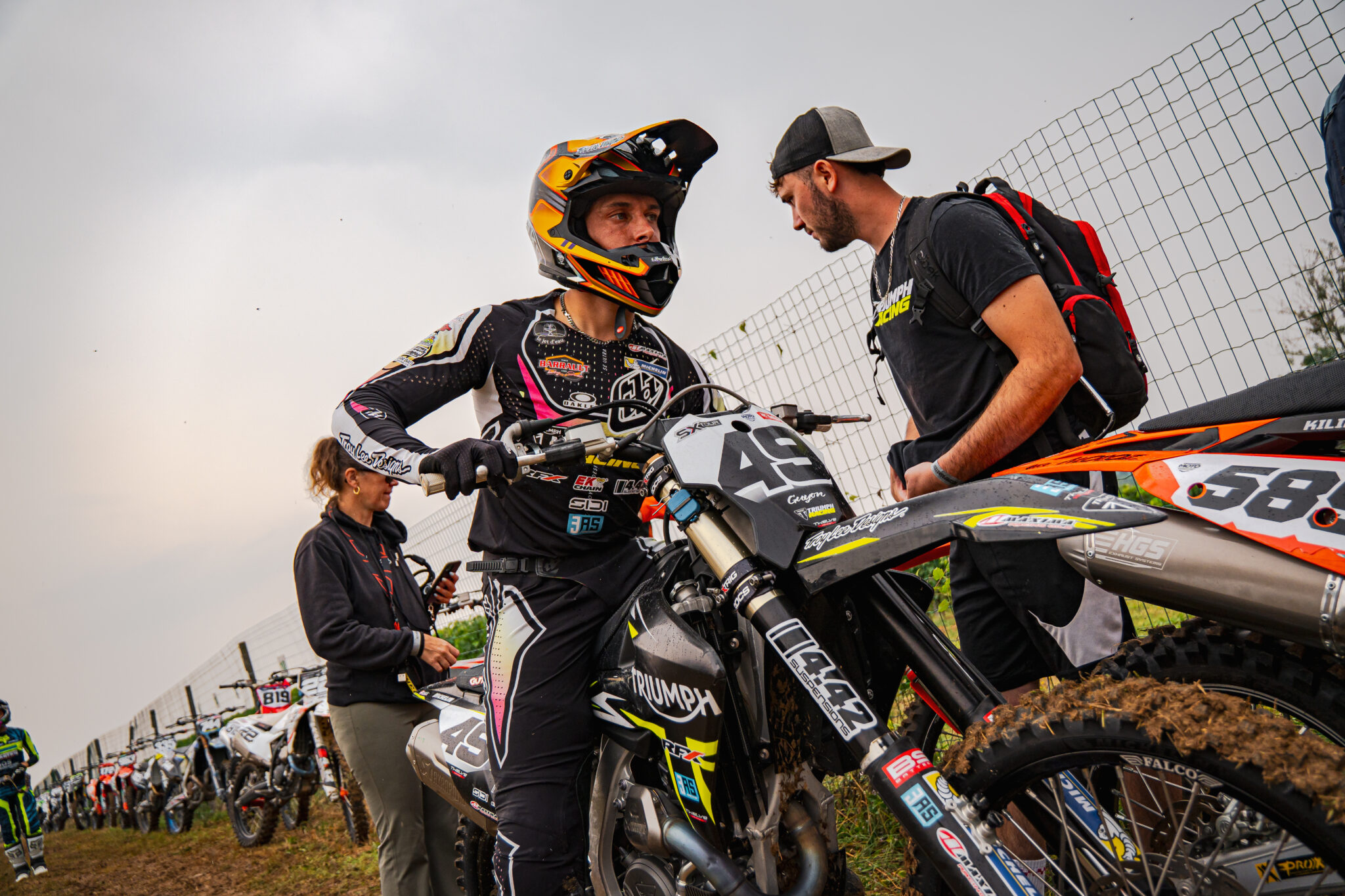
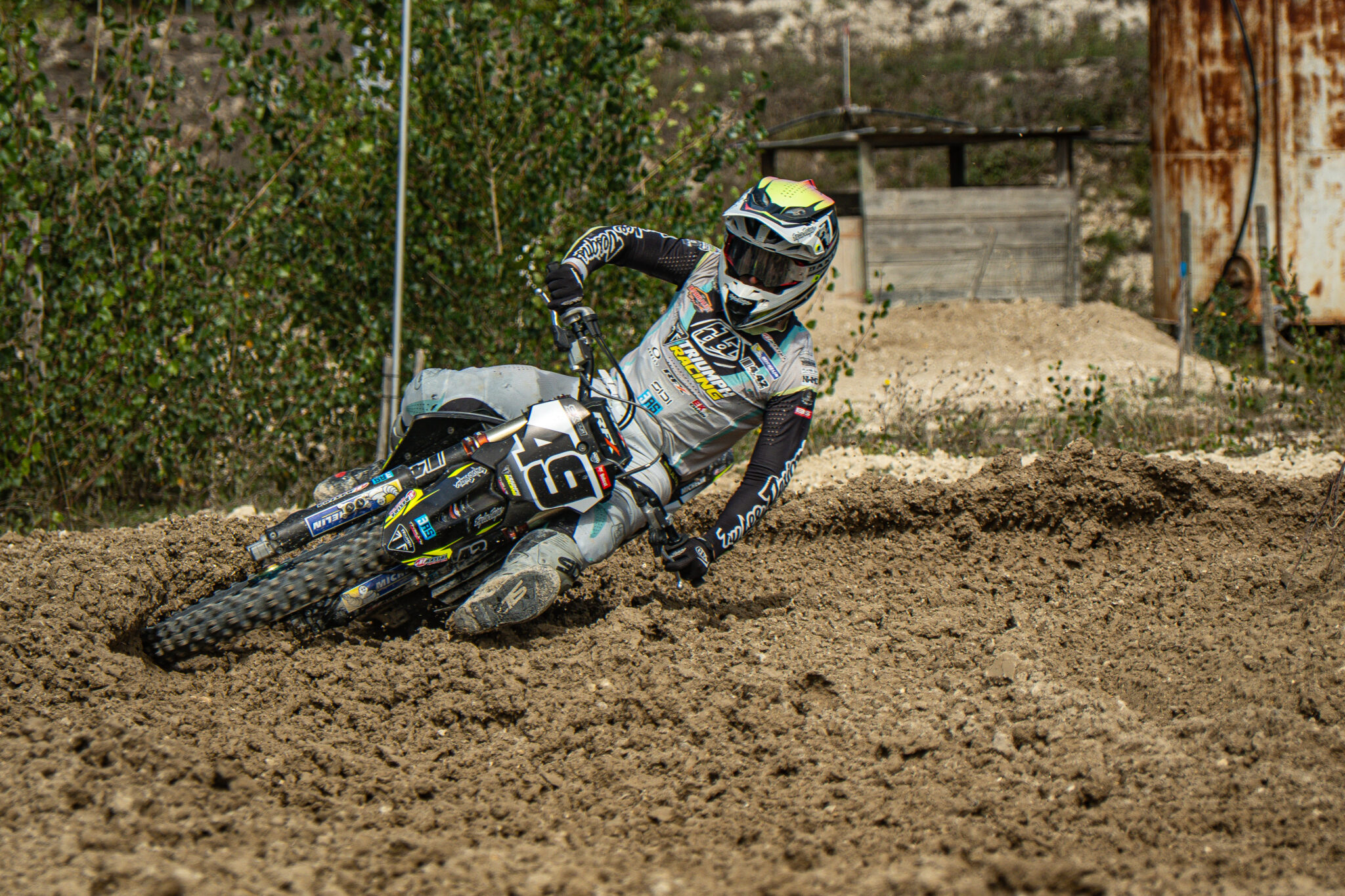
That’s why I decided to move up to the 450cc class in 2025. It came together quite late with Triumph, and I didn’t get the bike until mid-January. I wanted to start afresh on a new bike, and in a way, I was a pioneer. I set myself new goals and focused on the French Championship. In the end, it was a good decision for me.
You’ve never really lived an ordinary life. Your childhood was different, and today your daily routine is still different from that of most people. You don’t go to work in the morning like they do. As you’ve got older, have you realised just how different your life has been?
Guyon: Yes, definitely. My mother comes from a high-level figure skating background, so she knows the sporting world very well. My father, on the other hand, isn’t particularly passionate about sport. He loves mechanics, but nobody in my family had ever raced motocross before me.
One day, I nagged my parents for a little bike, and that’s how it all started. There was a motocross school near our home, and gradually they let me go there. The original goal was never to become a professional athlete. I was the one who set that ambition for myself. It was my personal goal, and my parents were there to support and help me. They never forced me to ride a bike. I could have decided to stop from one day to the next, and they wouldn’t have had a problem with it. I was free to do what I wanted.
The discipline and lifestyle were things I imposed on myself. I wanted to perform in this sport. Not being able to go out or live the same life as other young people my age never held me back. I didn’t feel hard done by. Today, I make a living from my passion. But as I get older, I also realise more and more how fortunate I am to do what I do. I’ve never had to work in a factory. Sport also teaches you a lot about life in general.
Do you ever think about what you would do if riding a bike was no longer an option?
Guyon: Yes. I’ve thought about it several times because I’ve considered giving up riding on a few occasions. I don’t see myself coaching riders. I enjoy doing it occasionally, passing on what I know and so on. But doing it every day or throughout an entire season isn’t for me.
On the other hand, I could see myself working for brands, perhaps in sales or something similar. I generally enjoy business, and I think I could eventually work for a brand in the motorcycle industry. My life revolves around bikes. I’d like to stay in that world.
We’ve talked about your parents. If they’re still involved today, their role must be different. You’re financially independent now. The financial investment required to get you to this point over 10 or 12 years must have been enormous. We see families competing in the European and World Championships and joining teams, but the expenses don’t stop there. Ultimately, very few riders make a decent living.
Guyon: That’s true. My journey has been unusual. My parents never wanted to put all their money into motocross. That was completely out of the question. They weren’t prepared to ruin themselves financially so that I could race. The aim was to support me as best they could without ending up broke.
As an example, when I was younger, my father built a camper van himself. He took an old Iveco, extended the chassis and added a removal van body to it. He bought a damaged caravan and put all the interior fittings inside, and we ran it on used cooking oil. We’d stop at restaurants to fill up! That gives you an idea of how my parents approached things.
They would tell me, “Don’t worry, we’ll find ways to get you to the races, but we’re not going to buy a €150,000 motorhome, and you won’t have 15 brand-new bikes.”
My father also believed that I should ride different brands. That’s why I became French Champion on both Cobra and TM bikes. He didn’t want to buy the established brands or simply follow everyone else. He thought that if we rode the least-represented bike, we’d have a better chance of getting support. We wanted to find sponsors to make up for the money we didn’t have. That’s how I was able to get results in France.
For my first season in the EMX125 Championship, I wanted to contest the entire series. My father told me we couldn’t afford it because it was too expensive. Instead, we agreed that I would race the EMX125 round in France. I had a chance to showcase myself. I rode well that weekend, and the following day I signed a contract with VRT.
From there, Mickael Vrignon took me under his wing, and I can never thank him enough for everything he did for me. He helped me enormously throughout my career. I was 14 when I left home. Mickael built an annex at his house so I could have my own apartment, and that’s how things really got started for me in the European Championship. My parents told me, “This is your moment. Now it’s up to you to seize the opportunity.” And that’s what I did.
There are countless stories of parents spending €50,000, €80,000 or even €100,000 on a season or a team so their son can race in the European Championship.
Guyon: Yes, but that wasn’t the case for us. My parents couldn’t afford to do that in the first place, and even if they could have, it wasn’t what we wanted. I would have felt terrible knowing that my parents were spending all that money just to get me into a team. We already take enough risks as it is, even when we’re young. At some point, paying money to take risks is inconceivable to me.
When you were racing the World Championship, did the reality of being a professional rider match what you had imagined when you were younger and dreaming of competing in the World Championship?
Guyon: There are some great aspects and some not-so-great ones. Overall, I’d say I remember the good times. Having a mechanic and getting on a bike that is always perfect — I’m talking about my experience with VRT here — makes those seasons really enjoyable. At the time, I didn’t realise how lucky I was.
Then there are the downsides, such as recurring injuries. My knee has taken a real beating. I’ve torn my ACL twice in the same knee, and I injured it again last year. These injuries take time to recover from and can keep you out for a long time. The problem is that mine happened at critical moments in my career, and that didn’t help my career opportunities.
Now you’ve set up your own structure and are focusing on the French Championships, as well as selected international races. You’re still riding, still competing and still aiming to perform. Your daily routine must be different from the years when you were a GP rider. Is life easier now?
Guyon: Easier? No (laughs). Different? Yes. I still make a full-time living from motocross, which is really cool. I’m fortunate to have partners outside the sport who support me financially. If I ride well, I earn bonuses. The better I ride, the better I earn. However, I have to manage everything else myself. I do all my own mechanical work during the week, and I’m on my own. When I get back from training, it’s time to wash the bike, maintain it and prepare it.
I also have to manage my budget. I have a budget from my partners, and I can’t blow it all. I need to be smart and use that money wisely because brands are contributing less and less. Well, less than they would if you were racing a full GP season, which is understandable. The economic climate doesn’t help either, and everyone can see that.
But I enjoy the management side of things, even if it takes up a lot of time and energy. I wear several hats: I’m the rider who manages his programmes and trains, and I’m also the mechanic during the week. Believe me, it’s hard work! We recently had a major recall on the bikes, and I had to change all the cylinder heads. When things get really hectic, my father helps me out, or steps in when the engine needs to be completely stripped. Otherwise, I manage everything myself.
You have new responsibilities. You’re an adult now. You have to support yourself financially, perhaps think about starting a family and plan for the future. Has growing up and changing your goals altered your outlook on sport and your relationship with it?
Guyon: Yes, absolutely. I have a girlfriend, and I make an effort to spend more time with her. As you get older, you start thinking more about the future. It’s a slightly more conventional life, you could say. This kind of programme keeps your feet a little more firmly on the ground.
You can make a living from it now if you get results. I spend much more time at home in Poitiers than I used to. In previous years, I was always travelling here, there and everywhere. I enjoy this lifestyle too because I’ve been able to invest in my workshop, which is worthy of a GP team, and I’ve also built my own practice tracks. When I’ve been racing at the weekend, I’m happy to come home and enjoy being there.
When you look at the careers of riders like Soubeyras, Aranda and Desprey, you realise they haven’t done too badly. You can have a great career and race the World Championship without ever becoming World Champion. They are probably making a better living today than someone finishing eighth in GPs. There are opportunities everywhere now, enough to fill a racing calendar, travel and earn prize money. As we discussed, the GPs aren’t the ultimate goal.
Guyon: Given Infront’s economic model, I don’t see the point of racing the World Championship as a privateer. People sometimes ask me why I don’t enter one or two Grand Prix’s. But those weekends cost me a fortune, with no financial return whatsoever. Yes, the tracks are fantastic, but the riders aren’t paid by the promoter. It’s a shame, but it’s also one of the reasons the grids are so empty.
Some riders manage to make it work, like Jan Pancar, but this system massively reduces the opportunities available to riders. I’m going to race in India and Germany. You can easily fill a calendar with those kinds of events throughout the year. If you ride well, you go home with prize money. Today, I’m part of the working world. We all have bills to pay, and these races allow us to make a living.
Is the level of risk you take different nowadays?
Guyon: Yes. Given how many times I’ve been injured, I’ve eventually become aware of quite a few things. When I need to take risks, I’m now conscious of the risks involved. Motocross remains a very dangerous sport, and sometimes taking a risk simply isn’t necessary.
For example, two weeks ago I was racing at an event in Basly, Normandy. I was ill. I wasn’t going to risk my life while I was sick. When I was younger, I would have put my head down and pushed on, even if it meant crashing heavily. But if you get injured, you don’t move forward; you go backwards.
My approach and the way I do things are different now, and I think that’s much better. It’s better to be on the start line every weekend, even if you don’t perform as well on certain occasions. Finishing 4-4 is good enough to fight for a championship position, and it’s better than risking an injury to finish 2-2. Brands are also looking for riders who consistently finish near the front in championships.
Do we know what you’re doing for 2027?
Guyon: Yes. I’ll continue with the same programme on a Triumph, still in the 450cc class. It’s a bike I really like, and things are going well with the brand.
I’m currently getting in touch with all my partners again, and it’s encouraging because I can see that many brands are happy with my season and my communication work, and they’re renewing their support for 2027. It’s great to have loyal partners and to be able to approach the season feeling secure. I’m not someone who constantly jumps from one thing to another, either. I take my commitments to my partners seriously.
What advice would you give to the next generation? I’m thinking of riders like Goyer, Bruneau, Cazet Mennillo, Diss-Fenard, Herzogenrath and Buysschaert — the young riders in the 2026 EMX125 Championship who hope to make it in this sport. You’ve been in their position yourself.
Guyon: My advice would be to plan their careers carefully and avoid spreading themselves too thin. It’s easy to say, but making the right choices and surrounding yourself with the right people is crucial.
They need to look at where riders are performing well, who they’re working with and why. They need to be curious and do their research. They should try to secure opportunities that are realistic and viable, in places where they can see that things are working for other riders.