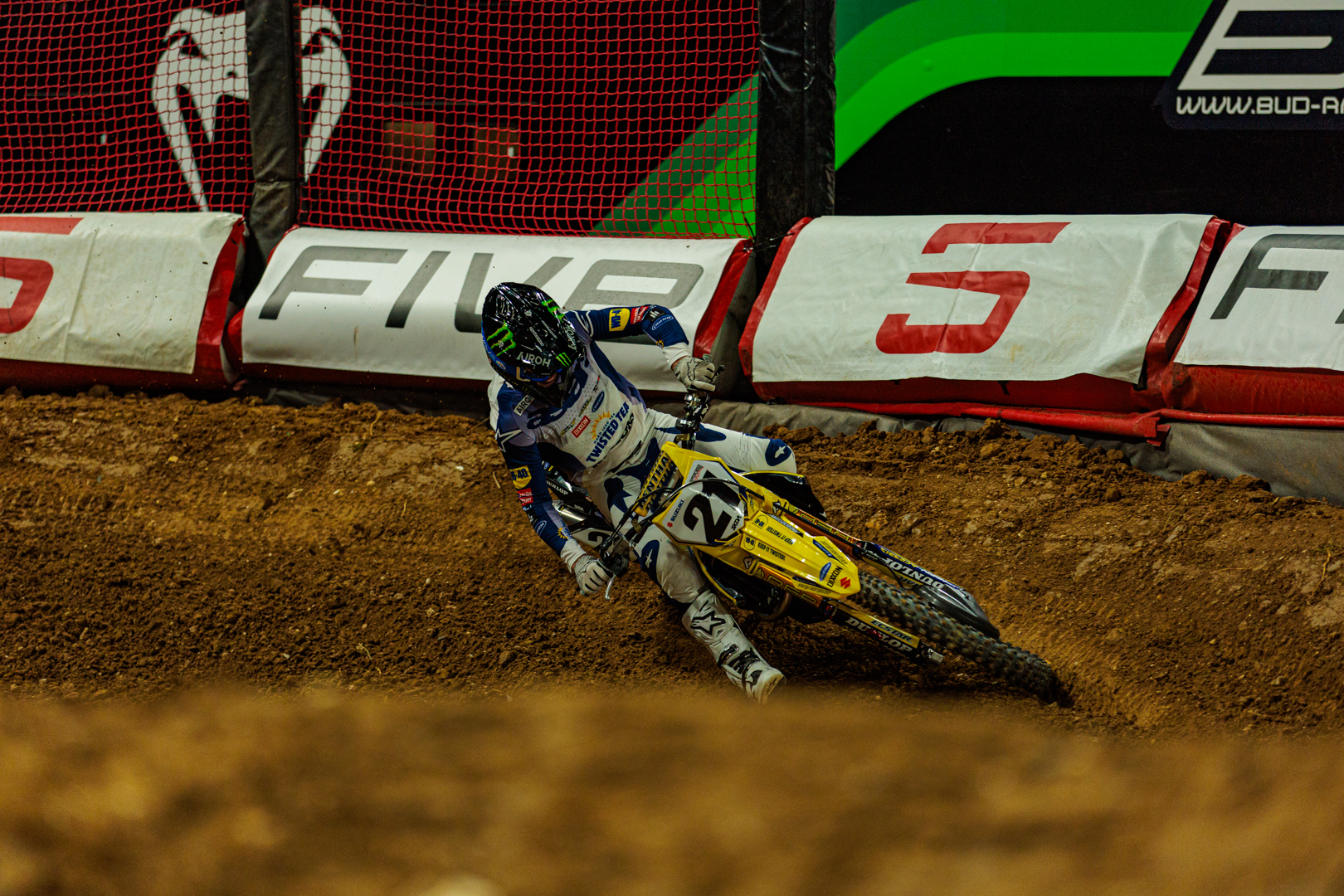






It was the ClubMX Yamaha amateur rider’s first professional Supercross event, and he spoke about his journey, his European experience and his ambitions for 2027. Interview by Marco Kamper.
Jesson, it’s fair to say that not many people in France know your name or really know who you are. On Saturday, you won the SX2 class and said on the podium that you weren’t expecting it, and that nobody else should have been expecting it either. What have you been doing recently?
Turner: This year, I’ve been racing the SMX Next Championship in the United States. To be honest, 2026 hasn’t really been a great year for me. I haven’t put together any particularly impressive results. I raced Loretta Lynn’s, where I finished third in Open Pro, before dislocating my shoulder in another class. I also raced a few rounds of the 250 outdoor championship. I did a handful of those to get my feet wet. I’d say this Paris event is simply my first professional Supercross.
So, I’m racing as an amateur in the United States and I’m part of the ClubMX Yamaha team over there. I’m just trying to travel around the world during the off-season. I’m here to learn and gain experience.
I know you’ve raced in Assen, in the Netherlands, and also in Germany at Stuttgart. How did you end up racing in Europe?
Turner: Lukas, the owner of Luke’s Racing, sent me a DM on Instagram. He asked if I was interested in coming over to race in Germany. I spoke to my manager, Daniel Blair, and told him, “Hey, I got this message from Europe.”
Daniel said, “Yeah, 100%, we’re going to make it happen.” The team and everyone involved wanted me to race. At ClubMX, they want me to learn, gain experience and be able to travel around the world.
Honestly, it’s awesome! I explained to them that I needed to ride a Yamaha because I have a contract with Yamaha in the United States. So, they found me a bike.
I raced a completely stock Yamaha in Stuttgart and Assen. Both times, it was completely stock. This weekend was pretty much the same, although I have a different ECU that I brought over from the USA. Obviously, I also brought my suspension and a few other parts. But the engine is completely stock, 100%. They gave me an exhaust because they didn’t like the stock one, but personally, I told them I didn’t really care. It doesn’t make much difference to me.
Then I went to Assen. It was my first time outside the United States. It was cool. The track was really small. It was also the first time I’d raced against riders who weren’t American. That was pretty cool. On the first night, I finished second. On the second night, I led the entire main event before crashing just before the finish. That’s pretty much what I did here! In Stuttgart, I won the second night!
Can you tell us a bit about your experience in Europe? You’re discovering a new culture. What’s it been like?
Turner: It’s absolutely crazy! The best way I can explain it is that it’s nothing like anything I’m used to. Everything here is completely different, and that’s what makes it really cool. I’m really enjoying the experience. I love discovering new things and trying new experiences. The food, for example, is completely different!
Everything is different. The people have been amazing. Everyone has been extremely kind to me and welcomed me with open arms. It’s really awesome. The people I’ve met have been super nice and have made this experience incredible. I’m enjoying every minute of it.
A word on the Paris track. They changed the whoop section between the two nights. What did you think of that?
Turner: I was honestly pretty frustrated, to be honest! Obviously, they were big and difficult, but I felt like that was one of my strengths on Saturday. So, naturally, I thought, “Damn!”
That’s where I thought I could make the biggest difference compared to the other riders. Then they took away the one section that allowed us to open up gaps. There weren’t any ruts, the track was hard-packed and slippery. Overall, it was pretty easy. They prepared the track and removed the only place where you could really make a difference.
Some riders were better on Sunday than Saturday, and vice versa. For me, I was better on Saturday and didn’t perform as well on Sunday. A lot of it came down to the start. Once you found your position in the pack, you tended to stay there. It was really difficult to pass.
As long as you didn’t make a mistake, you were pretty much guaranteed to hold your position.
You see this kind of whoop section in US Supercross and Arenacross as well. Have you raced Arenacross before?
Turner: I’ve only raced one Arenacross event, in Guthrie, Oklahoma. But it was in a big arena, so it was more of a format that resembled Supercross. The whoops were really big.
But when it comes to hitting big whoops, honestly, it’s all about repetition. You have to go through them over and over again. That’s how you learn and build confidence.
Last year, for example, my trainer was Chad Reed, and he wouldn’t let us jump the whoops during training. He’s a big believer in blitzing them rather than jumping them. We worked on whoops a lot with him, very regularly during training. That really helped me build confidence.
Watching you ride, I thought you had quite a European riding style. You were standing up everywhere, taking turns from the outside and sitting down really late. Where does that come from?
Turner: I don’t know. It’s simply one of my strengths: staying standing on the bike. Honestly, one of the things I’m working on right now is trying to sit down a little more because I ride standing up a lot.
But I watch other riders a lot. I particularly watch a lot of European riders because I follow the Grand Prix series. You can learn so much by watching other riders. So, I try to take inspiration from everyone, pick out the things that could be useful to me and apply them to my own riding.
It’s just what works for me. I tend to ride standing up a lot, and it’s become my riding style.
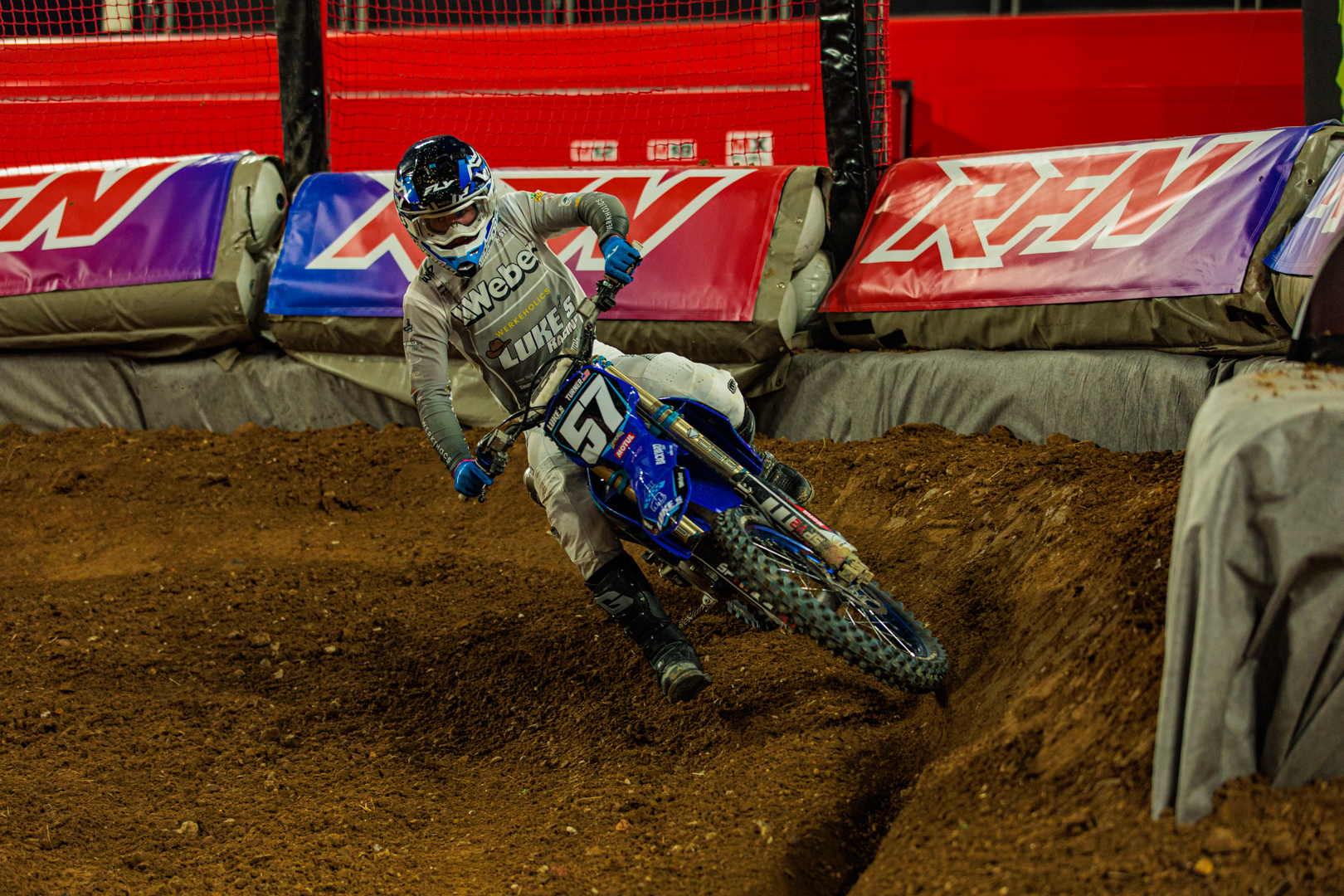
How much closer was the Paris track to the US tracks you’ve experienced racing SMX Next?
Turner: Paris was much closer to the tracks in the United States. In Stuttgart and Assen, the stadiums were really small. The jumps were pretty easy and the tracks were more accessible.
Here, it was much closer to a proper Supercross track. The track was much more complete. Obviously, it’s not exactly the same, and there are always going to be differences. The rhythm sections are different, the whoops are different and the dirt is different. But in terms of its overall design, this track was much closer to what I’m used to. I felt much more at home.
When I walked the track, I knew exactly which rhythm sections we were going to do. My teammate Stefan [Ekerold] said to me, “Really? You think we’re going to do it like that?” I told him, “Yeah, watch.”
Then, during press day, we went straight through those rhythm sections exactly as I’d imagined. I thought to myself that I was really in my element. I arrived at the track for press day and hit all the rhythm sections straight away. I also hit the whoops from the beginning. I felt really comfortable on the track, whereas the other tracks were a little easier.
It was also much harder to make a difference on lap times in Assen or Stuttgart because everyone was fast there.
What are your plans for 2027?
Turner: For now, I’m still committed to my team, ClubMX Yamaha, to compete in the SMX Next Championship. SMX Next is now a proper series, with a full calendar and its own championship for 2027. So, I’ll be racing that.
Then, during the summer, I’ll probably race the Canadian Championship, doing both championships alongside each other. Nothing is official yet, but that’s what I’m thinking at the moment and I hope we can make it happen.
I really want to race as much as possible and gain as much experience as I can. There’s no better training than racing!
Wouldn’t you personally prefer to race US Supercross?
Turner: Yes, but the real question is whether it would be beneficial for me. If I can race SMX Next and win the championship, or go to a Supercross round and finish, let’s say, tenth, which one is going to look better on my CV? I’m thinking more about the future of my career rather than just what could happen to me right now.
I want to choose the option that’s going to help me in the long term, rather than doing something that’s fun and looks good in the moment but might not necessarily benefit me as much further down the road. I think it would have to be the best option for my future.