








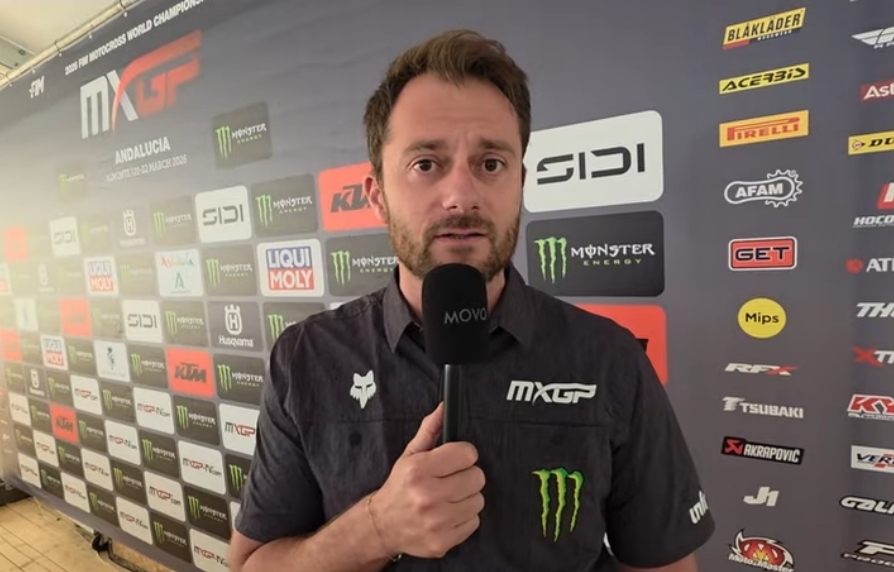
Jonathan McCready catches up with the man in charge at InFront Moto Racing, David Luongo, to discuss the 2026 MXGP season and other topics, including the chances of an MXGP/AMA combined race!
David, we’re here in Spain for the first European round of the season. It’s a great track—I’ve never been here before—and the racing has been fantastic so far. What are your thoughts?
David Luongo: Yes, it’s the first year here, so considering the short time they had to organise everything—we finalised the contract only five months ago—it’s a very, very good first edition in a beautiful region of Spain. In terms of the crowd, we’ve had one of the best attendances ever in Spain, so I think it was a very good decision to come here. With more time in the coming years, they can improve the facilities around the track.
The track itself is very good—demanding and technical. It’s sandier than what we usually have in Spain, but I think the riders really appreciated it. We saw great racing yesterday and again today in the European classes. It’s been very exciting, and we expect a great GP.
We’ve just had the EMX2 race—again, a lot of talent. When you look at MXGP, many riders come through MX2. Looking at America, with Dylan Ferrandis, the Lawrence brothers, Jorge Prado and others coming through MX2, does that make you proud? It shows the system is working on both sides of the Atlantic.
David Luongo:Yes, it’s now almost a three-decade strategy. One of the most important decisions we made was to create this pyramid system—from as young as six years old all the way to professional level. From 65cc through EMX250 and into MX2, riders develop step by step. When they reach MX2, they already have the speed to fight for wins.
This system creates fantastic riders every year and is designed to bring them into MXGP to raise the level of the premier class. Some go to the U.S., some stay in the World Championship, but overall we see many top riders on both sides of the Atlantic coming from our European system. Our goal is to create great riders—and in that, we’ve been very successful.
The MXGP class is stacked this year—Jeffrey Herlings and Tim Gajser changing teams, the Coenen brothers, Lucas Coenen, Kay de Wolf. Some of these riders might go to America in the future. Do you mind that? Does it help MXGP to see them succeed there, or would you prefer them to stay?
David Luongo: When a rider decides to leave, we can’t stop that—it’s their choice. What I see is that riders who stay can build incredible careers here. They become our champions. For the young riders you mentioned, they still have the opportunity to stay and grow within this championship.
It’s too early to say what will happen in the future. But when you look at the careers of Jeffrey Herlings, Antonio Cairoli, Tim Gajser and others, we are creating global champions.
I’m proud to see riders from our championship succeed all over the world. At the same time, we continue working to promote the World Championship and bring in new talent every year.
You and Davey Coombs seem to have a good relationship. There’s been talk of a joint AMA–MXGP event, which could be the biggest race ever. How close is that to happening?
David Luongo: It’s still an ongoing discussion—not only with MX Sports but also with the Feld. In recent years, we’ve come closer together, especially through the Motocross of Nations, which has been a big success—particularly in the U.S.
A joint event between AMA and MXGP, whether in the U.S. or Europe, would be a dream. It could even be bigger than the Motocross of Nations because it would bring all the top riders together. It remains a project we are working on. I will never say never—it’s something both sides are interested in.
Jeffrey Herlings has signed a two- or possibly three-year deal. He’s one of the biggest names in the sport. Is it important for MXGP to keep riders like him?
David Luongo: Jeffrey is a fantastic rider—you can see it in the way he wins GPs, his character, and how he represents the championship. But his career has also been built within the championship we’ve created, so it’s a shared success. It was the same with Antonio Cairoli and Stefan Everts before him.
Of course, having a rider like Jeffrey is great for the sport, but it’s equally important to keep bringing in new talent. That’s why the European and MX2 classes are so important—they ensure a constant flow of new riders into MXGP. Right now, the level in MXGP is incredible. You have multiple world champions racing together, and more are coming through thanks to years of development in the system.
Finally, regarding overseas races—can you explain the support given to teams for travel costs and the situation with prize money?
David Luongo: The system we introduced around 2000 focuses on creating a strong global platform. We invest in TV, promotion, and presentation, while teams and riders manage their own contracts.
This approach has significantly increased riders’ revenues compared to the past—many times over. It has allowed us to build a truly global championship, not just a European one.
We need to race in South America, Asia, and Oceania because those are growing markets for motocross. At the same time, we maintain the historic European tracks and aim for a balanced calendar of around 20 races.
This strategy has made the sport more global, more professional, and more popular—and you can see that in the crowds. Whether it’s Andalusia, Argentina, Shanghai, Australia, or South Africa, the fan support is strong.
One last question—when Ryan Villopoto came over in 2014, it raised the profile of MXGP in America. Do you think we’ll see another American rider make that move?
David Luongo: There are definitely more discussions and rumours now than before, mainly because we’ve gained respect in the American market. Our TV data and MXGP-TV figures show that the U.S. audience is among our top markets—often in the top three.
The situation today is very different compared to 20 years ago. The AMA has a strong national focus, while we have a global vision. That’s the main difference. But ultimately, both sides share the same goal: to make motocross more popular and more professional.