










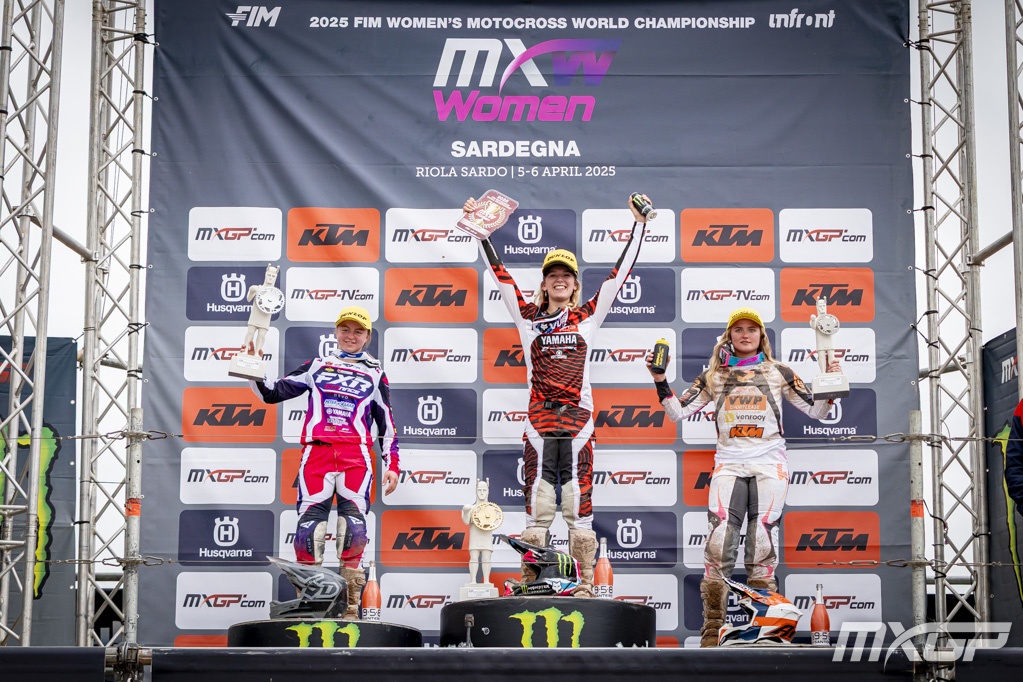
The 2026 MXGP World Championship calendar has been unveiled, and while there’s been a reduction of MXGP rounds from the usual twenty to nineteen, another change has quietly raised eyebrows: the WMX World Championship will drop from six rounds to five.
On paper, one round might not seem like a drastic reduction. In reality, it may have significant implications. The level of competition in WMX has risen sharply in recent years, with a deep pool of talented riders who continue to push standards higher. These riders have worked hard to elevate the profile of women’s motocross, and the championship should be evolving alongside that progress – not shrinking.
The logistical structure of the 2026 calendar also has an issue. With Australia scheduled as the final round, many riders will effectively contest only four events. Traveling to Darwin is a major financial and logistical undertaking, and while promoter support exists, it often isn’t enough to make the trip feasible for every competitor. The result is a world championship that risks being decided without its full field present.
How can the number of WMX rounds be increased?
One potential solution lies in rebalancing the existing support classes. The EMX250 Championship will run twelve rounds in 2026. It’s an excellent development series and an important stepping stone towards MX2, but twelve events may be excessive. Reducing that total to eight or ten rounds would still preserve its developmental value while freeing space for additional WMX races. Such a change could also encourage more MX2 wildcard entries on weekends when EMX250 isn’t running – something that would benefit MX2 grids, which occasionally struggle with rider numbers.
A similar argument can be made for the EMX125 Championship. These riders are still school-age, and balancing ten European rounds alongside national championships and academic commitments is demanding. The series is undeniably valuable – racing on the same tracks as MXGP stars accelerates learning – but trimming a couple of rounds could ease pressure on riders and their families while opening calendar slots for WMX. Decisions such as sending EMX125 to Turkey instead of WMX in 2026 only strengthen the case that scheduling priorities could be reconsidered.
Hard to make up ground
Having a championship over five rounds which is ten races, if a rider has a technical problem, if there’s a mud race which causes a DNF. It then becomes very hard to make up ground in the title race. Giving them the opportunity of more rounds would make it possible to mount a comeback.
WMX in America will continue to grow
Meanwhile, across the Atlantic, the American WMX series is set to run six rounds in 2026—already one more than the world championship. Although the global level remains higher, the AMA series is growing. If that momentum continues, there’s a real possibility it could close the gap. In a worst-case scenario for the world championship, top WMX Grand Prix riders might begin targeting the American series instead. Ideally, the flow of talent should move in the opposite direction, with leading AMA riders stepping onto the world stage.
Ultimately, the issue isn’t simply about numbers; it’s about trajectory. WMX is progressing, attracting stronger talent and greater attention. A championship on the rise deserves a calendar that reflects that momentum. Expanding the series back to at least six rounds – if not more -would send a clear message that women’s motocross is not an afterthought, but a growing pillar of the sport’s future.