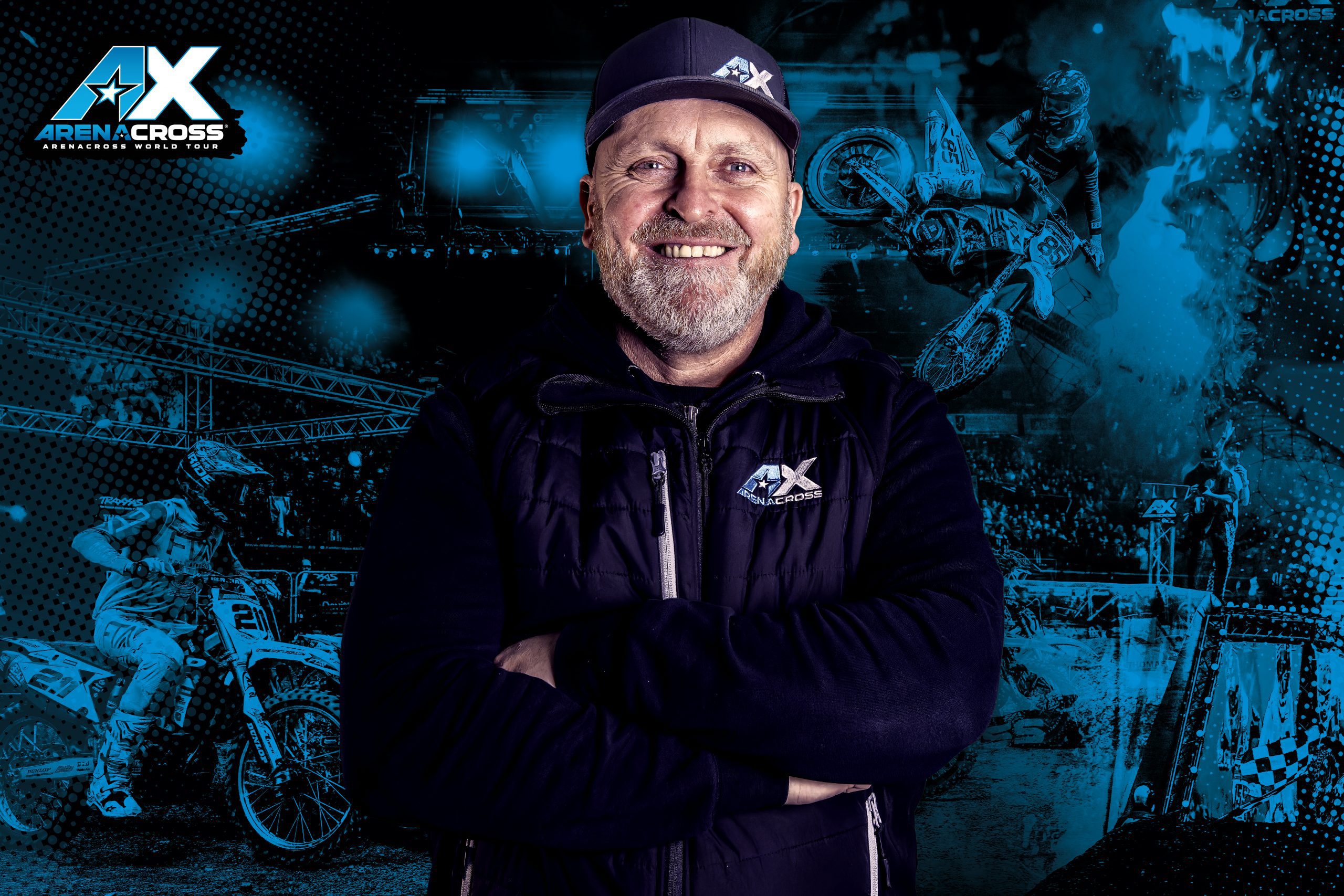
Few figures in British motocross have worn as many hats as Jeff Perrett. From his days battling inside the top ten of the British Championship and lining up on the world stage in the World Championship, to later becoming a respected journalist and voice behind the microphone and a key figure helping develop young talent. Perrett has experienced the sport from almost every angle. His journey through racing, media, team management and commentary gives him a unique perspective on how motocross has evolved in the UK and beyond.
We caught up with Perrett to look back on his own racing career and the path that eventually led him into commentary and media roles within the sport. He also opens up about his involvement in projects such as youth development programs, his experiences working at major events like Arenacross and World Supercross, and his thoughts on the current state of British motocross. Along the way, he shares honest reflections, stories from the paddock, and insight into where the next generation of British riders could come from.
GateDrop: So, Jeff, we’ll go back to the start, because sometimes I feel like people forget, but you were actually a pretty good rider yourself. For the people that don’t know, can you just tell me a little bit about your career? From what I’ve been told, you were pretty much a solid top 5-10 British guy and a solid GP privateer?
Perrett: ‘From what you’ve been told?’ Don’t say that you are making me feel old (laughs). But that’s correct. Back in the day, to do GP’s, you had to be on the grading list before you could even go. So, you had to finish top ten regularly in the British Championship, If I remember correctly only eight riders per class would be eligible for a GP licence to go and race them, something like that. I worked my way up to that from when I went into adult racing in 1991. I quickly got my expert points, raced the British Championship, and then got good enough to race GP’s. I started racing them in 1995, and I did six years of GPs from 1995 to 2000 in the 250 class.
My best end British Championship result was fifth in the British 250cc Championship in 1998 but it should have been fourth, in the last race of the year at Lyng my bike seized and I lost fourth in the Championship to Davy Campbell. It’s the only time I’ve ever really let my emotions get the better of me and kicked my crash helmet like a goalkeeper all the way down Cadders Hill because I was that gutted. I was always sort of in the five to tenth pack and pretty consistent for a few years there. I was never on a major team but always had some good people behind me like Poole Yamaha, Kinson Kawasaki and Vic and Anne Eastwood. The Eastwood family were great to me and I learned a lot from them all and travelled to the GP’s with Mark and Scott, which was a lot of fun. I picked up support from Animal clothing and became their recognised motocross athlete in 1996 and they supported me all the way to then end of my career so that was pretty cool. Being in high street stores with pictures on the wall and all that kind of stuff. They were a really cool sponsor, they didn’t really care about the results. It was more about having fun at the races. Their sponsorship manager Steve Kitchin even said to me at the start ‘we’d rather you do something cool like a big whip or have a big bail out trying than winning’ which was pretty cool to hear. So I always tried to have fun out and lay a few whips down where I could. Obviously I tried to avoid the big bail out option. I’ve still got a load of Animal clothing still fresh in the packet, where it’s staying, because I don’t think it will ever fit me again.
GateDrop: Some things never change. I mean, what was it like for you going to GP’s from the British Championship? Even today it is difficult so how did you find it? It’s different tracks you need to adapt…
Perrett: Of course the sport has changed. It’s different now in many ways. We had all varying terrains and went to some amazing natural circuits more back then and a lot more riders travelled with their mechanics and other riders on the road back then. There was less GP’s and more time between races. It was awesome road tripping around Europe. I loved racing GP’s, they genuinely were some of the best days of my life for so many reasons. I think it was probably because I didn’t have the pressure of being on a major team, and I was kind of a privateer across the board. I was on a few towards the end, but those early days, I was a genuine privateer. I rode for a Yamaha dealership, and then a Kawasaki dealership.
I went to the GPs very much with the attitude of I can’t believe I’ve got to this level. I’m going to embrace it. I’m going to enjoy it. I never felt any pressure at the GPs at all. I went there and thought, right, I’m doing something I love, genuinely doing something I love. If I qualify, then brilliant, fantastic, I’m earning money, and I’ve got more chance of earning again in the race. But I never got worked up, you know, like regards of the qualifying, because I thought, if I make it into the race, brilliant, bonus. If I don’t, I’m getting to see the world. I’m travelling with my family and my friends. Yes, I’m going to watch a race that I’d love to be in but that’s the nature of where I’m at; I had a genuine dose of reality with it and still do. My died just after I turned 14 and through the process of getting my head around that I told myself and decided I wasn’t going to hold on to any anger and I was going to live my life to the full, do what makes me happy, never be motivated by money and have fun. My family supported me all the way and made their own sacrifices and we’ve done this whole journey as a tight family. My brother Shawn quit his own riding career to become my mechanic, my other brother Percy did extra hours as a bricklayer to help get us to GP’s and Mum was incredible in driving us all forward with it. She fell in the love with sport pretty straight away when we started in 1981 and within a year was on the committee of our local Hants & Dorset Club and later become secretary.
I was pretty good at qualifying, regards of making into the race at least. I think because I never got worked up about it at all and never got nervous at a GP. I was always more nervous when I went back home and raced. I used to race down the South West region, and I was probably more nervous when I turned up there because all of a sudden you are the guy with the target on your back.
I was a bit like, ‘Jeff’s doing GPs, he’s here, we’re going to put it to him this weekend’. So I was more nervous racing regionally than at a GP. I never sat on a start line at a GP, ever, and got phased by it. I always thought this is cool, this is brilliant. I’m going to embrace this. I’m on the start line with Everts, Tortelli, Bolley, Bervoets… the list goes on and I’m like, this is rad. I had nothing to lose and everything to gain, especially in becoming a better racer, a better version of myself.
GateDrop: You are a presenter and commentator now. Can you just take me back to the start and how all that came about? Do you remember the first race that you went on Comms at? I’m sure you were probably nervous for that?
Perrett: No, I wasn’t. I very rarely get nervous about anything, really, because life’s too short, you’ve got to embrace the moments that come your way. I’d already at that point been editor of Moto Magazine back in the day, for four or five years and that then came to an end. They merged with some other companies and magazine titles, and it was never the same as it was when Moto Magazine started and what we believed the ethos of the magazine should be. That’s when Matt Bates, who I’m now obviously still working for, introduced the Red Bull Pro Nationals. Matt asked me to be head of communications for that series off the back of my job as Editor of Moto Magazine. The job was to contact all the regional media, radio stations, TV, just manage the whole project, regardless of the market. He originally had Justin Morris to do the commentary with Christian Stevenson, DJ BBQ, who used to do the Arenacross, the American guy.
We were at Duns and for whatever reason, I still don’t know actually, Justin couldn’t make it, I can’t remember what it was but either way he wasn’t there. Matt just said, look, Justin can’t make it. Can you jump on the mic with Christian? I remember saying to Matt, well, yeah of course I can do that. I’m pretty cool with that but my other duties, just bear that in mind, because I’m not going to be able to pump out the media that you want while I’m doing that! But anyway I jumped on it and then later Matt had messaged me saying, right, I want you to do the commentary for all the remaining rounds. So I literally just fell into it and how it happened.
GateDrop: My next question was going to be about how much prep went into the first time you did it? But in a way, that’s quite good, because it means you’re quite natural and you’ve got a gift for it. So that’s quite good. But then I’m assuming the next weekend, did you do a bit of prep?
Perrett: I very rarely do prep, maybe that’s a downfall, I don’t know. I’ve got this far doing it my way. I mean I keep a track on results, which is easy enough with the internet but because I know most of the riders in the UK so well and for long I kind of have a big part of their career stored in my head. For the media interviews I’ve ever done, even at Moto and those full length written interviews or more recently the podcasts with the likes Ricky Carmichael, Johnny Rea, whoever, all the people I’ve interviewed and Doc Wob and I have had on our ‘Torq Moto Podcast Show’, written interviews and magazine features, whatever it may be, I rarely prep or think about it too much or get start struck as it were.
They are all human like me. I’ve got an idea in my head of how I want it to go and that’s it. I don’t even know what the first question is ever going to be until I sit down, literally, whatever we do, podcast included. I just think it’s not a natural conversation if you have a list of questions sat in front you to get through. The best way I can sort of describe that is, most people in are somekind of WhatsApp groups now, right? Okay, some people might have a regular routine that they do, like midweek footy or pool night, going to pup for a pint, whatever it is. So prior to that on the WhatsApp group it’s like asking the question, right, what are we going to discuss tonight when we meet up? It doesn’t work that way, that’s not natural conversation.
You sit down and more often than not, you just shoot the shit with no agenda but that’s where good conversation lies. If it’s too pre-emptive and too scripted I think you never get the real meat on the bone. I wouldn’t say it’s the art of doing an interview, because everyone has their way of conducting one. I just like chatting and having a relaxed general conversation. I think sometimes if you’re not listening to what people are saying and you’re so worried about what your next question’s going to be, the conversation doesn’t flow as much because you’re not really listening to what they are actually saying. I often find my next question usually lies in their answer.
GateDrop: With the commentary, you do Arenacross, I think you do some World Supercross rounds or do you do them all at the moment?
Perrett: With World Supercross, they first asked me to do that in 2023 I think at Birmingham with Roger Warren at Villa Park. They then asked me to do Abu Dhabi that year as well. They asked me back the following year, but I couldn’t do it. My mum was frail and nearing end of life care, so as a family we were all dealing with that so I didn’t want to travel out of the country. To their credit they asked me again for 2025 and after mum’s passing I was happy to committed to it. I didn’t do the first round in Argentina because they needed a Spanish speaking commentator, but then for all of the remaining rounds it was Lee Hogan and myself, not for TV, but as the event show hosts with another Aussie, big Dan Morgan as the hype guy. It was a good fun, I gelled with those guys right off the bat and enjoyed their company and getting it see the world a bit more.
The guys at World Supercross have stepped it up so much from the first one I did at Villa Park a few years ago, it’s rooted now and really going places I think. The difference I could tell just coming in from when I first did it to where it is now is a huge step forward. I think it was the breakthrough year for them last year. Honestly, the racing was so good and obviously helped. Their production levels are now much higher and polished and they’re rolling now so I think that’s going to keep growing in it.
It’s been a privilege and really nice to work with them. Obviously, just the calibre of rider that you’re commentating on brings something extra to it. It’s November, I’m in Australia, on the Gold Coast and the sun is shining . I’ve been strolling up and down Surfer’s Paradise beach taking in the sights and sounds, then the next day I’m watching Deegan, Tomac, Roczen, Webb and all the others go at it and calling the action, I mean, either way you cut it, that’s a cool thing to say.
I equally love working the Arenacross shows, of course, otherwise I wouldn’t have done them as for as long as I have. I’ve never missed a show since Matt started Arenacross back in 2003 at the O2 in London. I think I’m up to 105 shows now and myself and co-show presenter Matt Crowhurst have a blast out there engaging with the crowd. We’ve also got some brilliant riders in UK and Arenacross is an amazing show. Matt puts an incredible amount of time and effort into it and done an amazing job with it over the past 11-12 years introducing our sport to a new audience. I think the UK MX industry and more riders should get behind it more and I don’t understand why to they don’t, the numbers of people coming out to see it don’t lie, but that’s another conversation for another time otherwise I’ll be sitting here talking for another 30 minutes on that alone.
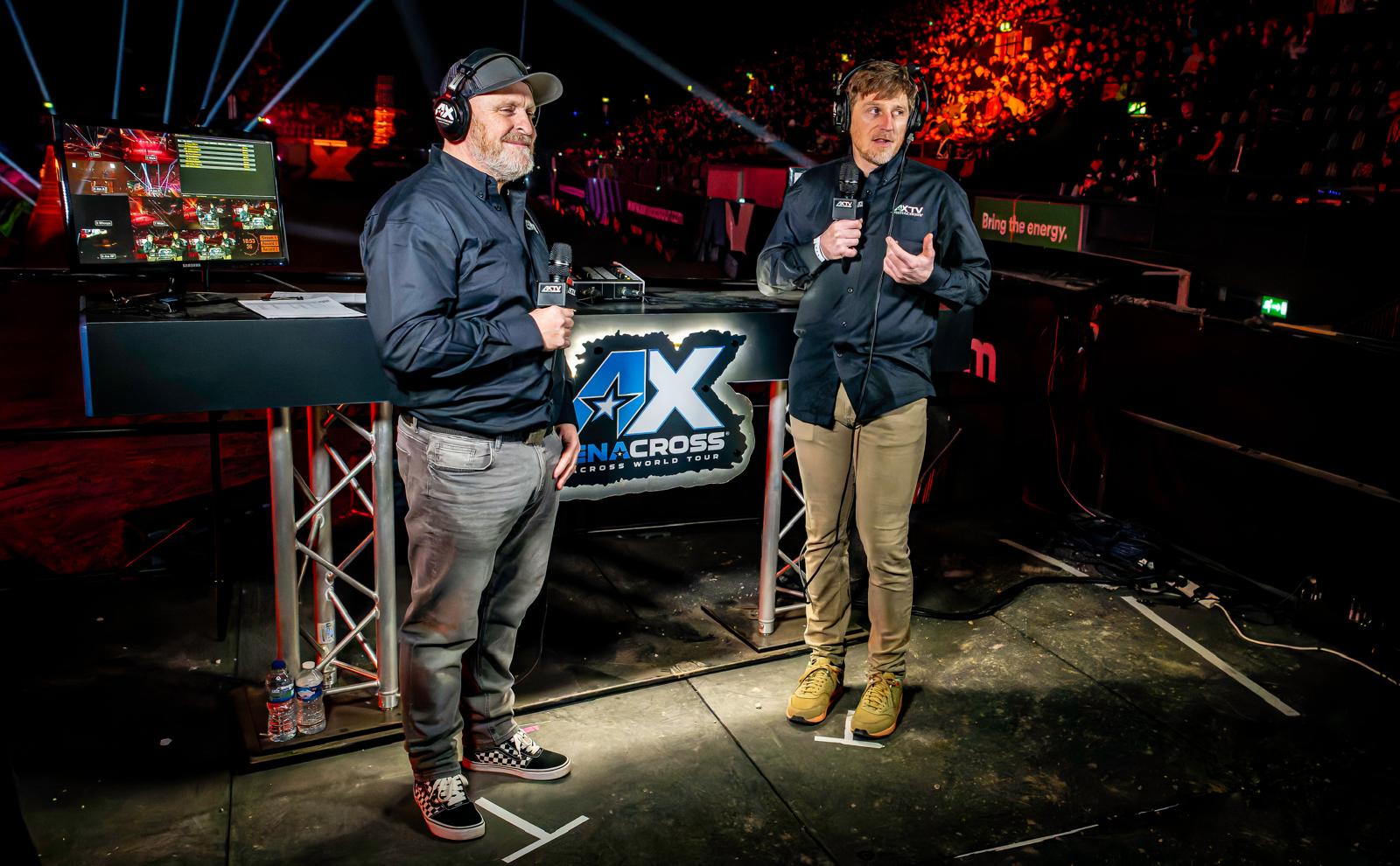
GateDrop: Also on a personal side, you’re still getting to travel the world and seeing bits of the world you might not necessarily get to see, so that must be quite cool as well?
Perrett: Yeah, I’d never been to Australia up to last year so that was cool albeit only for four or five days. I enjoyed all the cities we visited, the different cultures, the architecture. The schedule was pretty intense. Three of the four rounds were back to back – Australia, Sweden and South Africa. It was a cool experience. You get towards the end of it though and you’re a bit bombed out, jet lag and general fatigue catches up with you. It sounds glamorous but a lot of mental energy goes into it and at the end of the day you’re there to do a job. Fair play to the racers, teams, track and production crews, it’s much harder for them. I just rock up and get paid to say what I see for a few hours. Hopefully they’ll ask me back and I’ll get to do it all again this year. It would be cool to have one back in the UK, so hopefully that will happen also.
If it does, I hope loads of people go out and support it because that’s the only Supercross we’ll see in the UK. I’ve hear people say ‘why don’t we have a Supercross series in the UK?’ My answer to that is Arenacross is our Supercross in the UK. We’re not going to get a full UK Supercross series because we’re never going to get the big stadiums to run a series of that magnitude. You just can’t. Football and Rugby rule the roost in our stadiums, and when they’re not being used for that more and more major music acts are now using them. I can’t even begin to imagine what it would cost to hire a premier league football stadium. I’m sure if Matt Bates could turn the Arenacross series into a Supercross series in the UK he would already being doing it. I know, financially he puts his balls on the line every time he hires an arena, let alone a stadium. It’s slightly different for World Supercross as it’s a one event deal in each country for the best part, but no doubt the financial risk is same. So if they do bring a Supercross to the UK, that’s another reason as fans of off road motorcycling in general in the UK we all need to get behind it, the same goes for Arenacross.
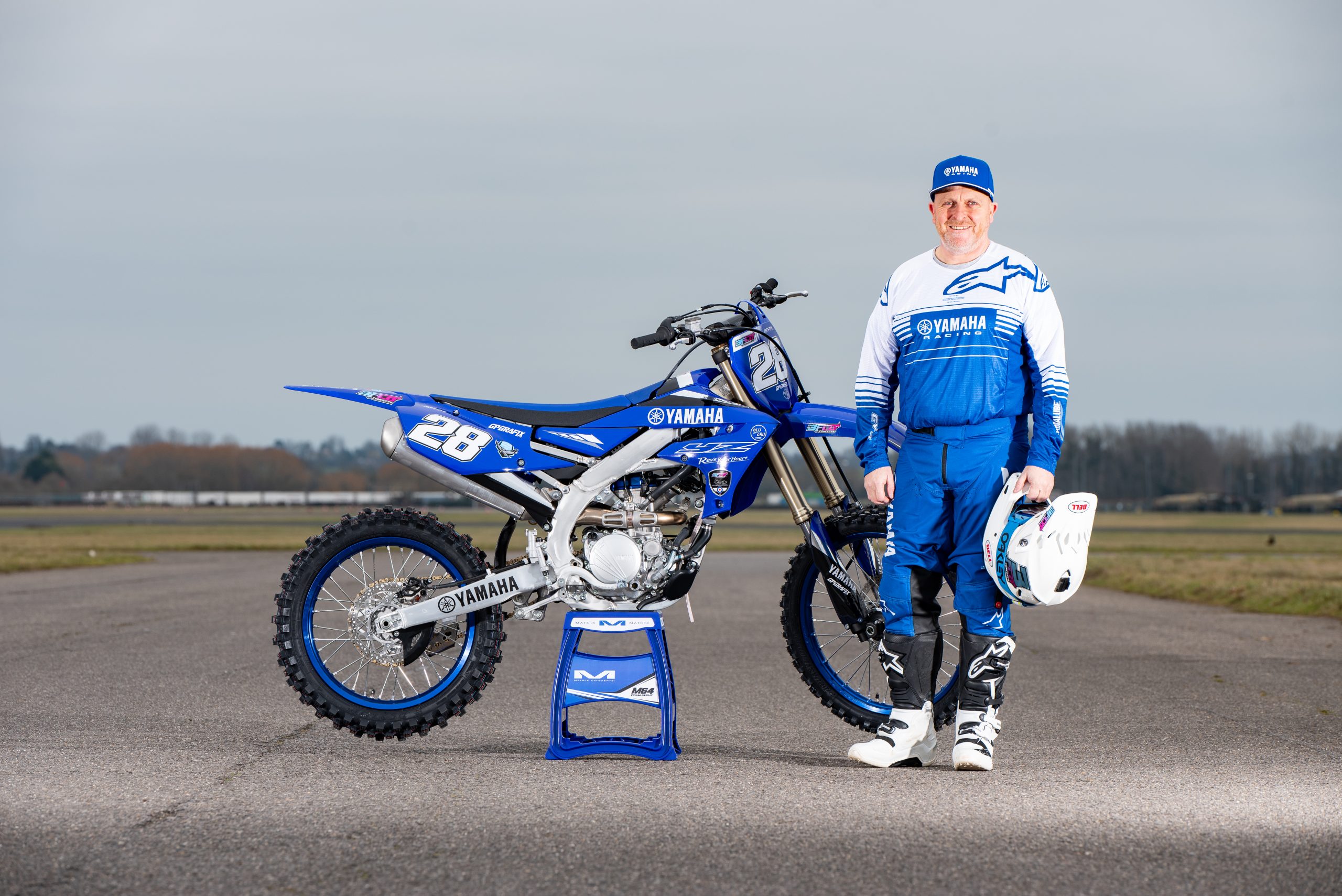
GateDrop: When it comes to UK motocross, you’re involved with the Blu Cru Yamaha setup. Can you just tell me a little bit about your role there and what the idea behind it is? I’m assuming it’s to help the British kids to show what GP racing is like and hopefully bring a few on in the process?
Perrett: Okay, before I do, I’ll just explain the back-story of how and why I’ve ended up working for Yamaha UK as an ambassador and their Blu Cru manager, because in a way it’s been years in the making. I started my own team – Twisted 7 Kawasaki – back in 2005 after helping set up and riding for the RRT Honda team and also being part of the team that ran the Isle of Wight GP in 2004. After a few years of running my own Twisted 7 team, Kawasaki UK asked me to manage their Team Green programme, which was a genuine honour with all the history and heritage it has behind it. I ran, and managed Team Green for 13 – 14 years, something like that. My connection with Kawasaki all stemmed from my magazine days, when I had my own column called ‘Rear Gunner’ in the back of Dirtbike Rider magazine and was winding down my career. The guys at Kawasaki said they’d help me out with a couple of 125cc’s. I’d reached my prime and I was just kind of riding for a bit of fun. So that was how my connection with Kawasaki came about.
Running Team Green came to its natural conclusion just because running the program was getting harder to manage, not for me as such but the concept. We had a lot of success in the 85cc classes with the likes of Dylan Woodcock, Jed Etchells, Lewis Hall, Kacey Hird, Joel Rizzi and Bobby Bruce but because Kawasaki didn’t make a 125cc, it was getting harder and harder to attract kids to the program because parents started to wise up and were asking, what happens after the 85cc? Some made the transition from the KX85cc to 250F well, like Dylan and Lewis but we had an issue with Bobby Bruce because he got so big so quickly he needed to go up to the 250F but he was too young to race one under the ACU ruling at the time. That kind of highlighted the problem further. So Kawasaki UK and I decided we’d just focus on a rookie 250F team, which we did for a couple of years and then the decision was made to focus more on MX1 and MX2. That’s when Ross Burridge at Kawasaki UK and spoke and decided it had been a great run and to call it a day and do something else. I can’t thank Ross and Steve Guttridge enough for the opportunity to run Team Green and the support they gave me down the years. I have a great relationship with them both and all the guys at Kawasaki UK, it’s was a big chapter in my career and life.
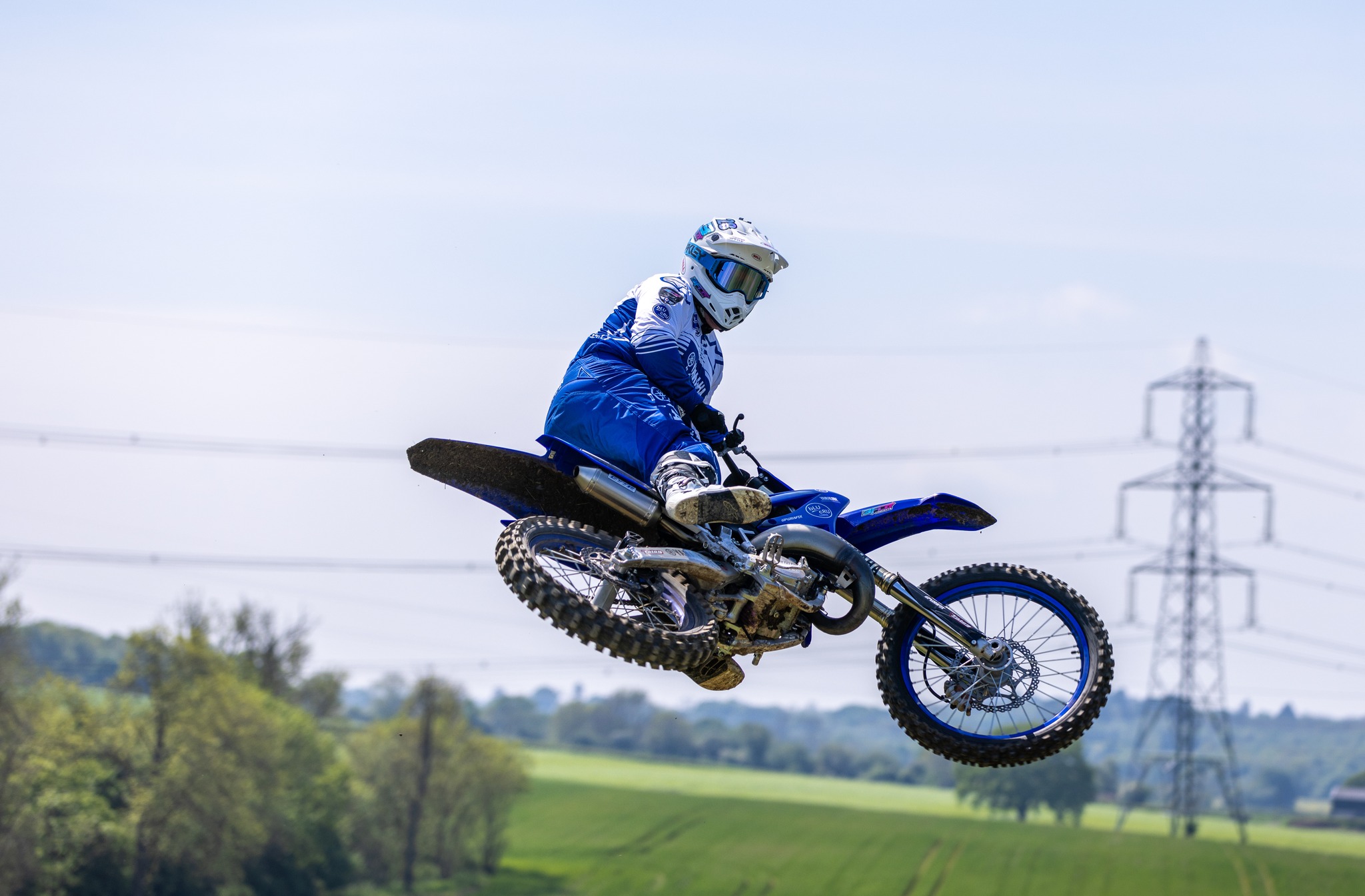
When managing Team Green came to an end I thought, right, I’m going to go back and run my own team again, but this time solely focusing on youth riders. So I came up with a new name for a fresh start – 3 Flo Concepts and got started. We had Drew Stock, Harrison Greenough and Zane Stephens on board for year one, they sorted out their bikes and I got everything else sorted. Mostly through my long-term relationship with Madison UK, so we were sorted with good product support. Then my connection with Yamaha came back the following year. I started my career on Yamaha and spent the largest percentage of it racing Yamaha.
I know Paul Denning, who owns Crescent Motorcycles and is Yamaha’s World Superbike team owner from racing youth motocross regionally when we were younger. I caught up with Paul again at our local practice track by chance and we started chatting and he asked what I was up to. I told him I was now running my own team and my plans for it. I then saw him three weeks later at the VMxDN at Foxhill and he said he’d been thinking about our discussion and said; ‘Why don’t you come into the shop and see if we can do something with Yamaha?’ 24 hours before our meeting, he texts me saying he’s got the new marketing manager for Yamaha coming in on the same day. Would I be okay if he’d come into the meeting and I sat down with him for a chat on where the sport is at in the UK, which of course I was more than happy to do.
I went in there just for a casual chat and an hour later, walked out of the meeting, not only with support from Yamaha UK and Crescent for my 3 Flo team but also for it be the official Yamaha youth team, and then the possibility of me managing their Blu Cru UK program and being a brand ambassador. A month later, they offered me the job. I didn’t go looking for it like some people thought I had. Some people probably thought I jumped from Kawasaki with the Yamaha option already on the table. It didn’t happen that way. As I said, I have a brilliant relationship with the guys at Kawasaki. Going back to Yamaha was a no brainer though and it’s a sentimental thing as well. I’ve gone full circle and it’s like being back home.
The Blu Cru program itself, that’s a Yamaha Europe directive. We take all the best Yamaha youth riders from each country and they get to race the Super Finale at the MXON. The number of riders that each country selects is based on the number of riders that sign up to the Blu Cru program. There’s a lot already signed up for this year in the UK. We’re now second in the number of riders signed up after Sweden I think, so that’s good. We’ve gone from about sixth or seventh on in the list up to second in the past three years, so it seems it’s now rooted and growing nicely.
The objective is you’ve got to own and race either a YZ65, 85 or 125 and race an FIM national championship to be in with a chance of being selected by a panel of judges to race the Blu Cru Super Finale. Myself, the guys from Yamaha UK and Brian Jorgensen look at the results, look at all the criteria, social media etc and then depending on how many spots we’ve got in each class, those riders then get selected to go and race at the Super Finale. Yamaha Europe than take the top three from the Super Finale and two wildcard picks and they get invited to the Blu Cru Masterclass and get two days of coaching with Gautier Paulin, Brain Jorgensen and Nancy Van Der Ven and at the end of those two days they chose one rider to get some genuine support from Yamaha Europe. The winning 125cc rider gets a supported ride with JK Racing to go and compete in the EMX125. We’ve had two British winners in the last two years, Jamie Keith and Drew Stock so that’s really cool.
In 2024 at the MXoN at Matterley Yamaha opened it for the first time for riders outside of Europe. The crew from Yamaha US came over with some riders and were that impressed by it, they went to Infront on that day at Matterley and said they’d love organise the Super Finale when the MXON goes to America and so they did, which was why we effectively had two super finales last year. We had the main one at the Swedish GP and one for American riders and the winners of the one in Sweden got invited to race at Ironman at the MXoN, which was cool, especially for our two British winners Drew Stock and Nixon Coppins.
How the Blu Cru program works in the in the UK is, you’ve just got to own a legitimately imported UK YZ from a Yamaha UK authorised dealer, it doesn’t matter how old it is, and you can sign up. You get a welcome pack and some Yamaha paddock Blu Cru clothing, we do a ride day where Brian Jorgensen and I do a bit of coaching. We’re going to hopefully add more of those days going forward. You don’t even have to be a top level rider, as long as your bike’s a legitimate bike, as in brought from a UK dealer because obviously there’s a lot of imports going around. Then we can continue to grow the program. The more people who buy legitimate bikes, the more Yamaha UK can invest into the program and give even more incentives and benefits of being a member of Blu Cru.
The end goal for me personally is I want to get it to a level where we can invest more in supporting British youth riders racing a Yamaha from grass roots to the sharp end and really make them feel like they’re part of a global family. A lot will hinge on budgets, what Yamaha can invest into it, time, all those things, that’s why we need more people buying legitimate bikes and not grey imports, but I would love to get it to the level that the Blu Cru UK program is supporting riders in some way, shape or form to go and race the European championships other than potentially winning the Masterclass.
Same goes for club riders in the UK in trying to help them become national riders, same goes for Arenacross, I think we should look at getting more kids riding that as well, it’s something I’ve been talking to Max Anstie about and we’re hoping to get something off the ground there, excuse the pun. Just try and do it and give the Blu Cru kids all these cool experiences that hopefully inspire them to become the best they can be.
GateDrop: I want to ask you about the British GP. So Matterley Basin, an unbelievable track, love it, I think one issue with having a GP there is sometimes it looks empty if you don’t get the crowd, obviously it’s a change for Foxhill this year. First of all what’s your thoughts on that, I’m quite positive about it, I think it’ll be better for the atmosphere, hopefully…
Perrett: I wholeheartedly agree. Now what I’m going to say, some people would say I’m biased. I’m not being biased but it will come across as being that, I was fortunate to race every GP there from 1995 to 2000. I raced six British GPs at Foxhill and as a rider the atmosphere was special and not just because it was my home GP. You come off the start, the start of a GP race is immense anyway, but you swept it into that valley back in those days, you really felt it, it’s was real, you hit this wall of sound, that and all the adrenaline smacked you the face and although you were in the race you still felt that tingle down the back of your neck, well I did anyway.
I absolutely agree with what you’re saying, Matterley Basin is an incredible venue. The issue with Matterley to a degree is it quickly became the victim of it’s own success I feel. We hit the ground running in the UK with that venue, to a magnitude that was never going to be matched. The first Motocross of Nations there was immense. It was rammed with something like 60,000 people there – it was one of the highest attended Motocross of Nations. We started so big and then obviously down the years, for whatever reason, numbers of people going out to watch GPs have dwindled. Then this amazing, but vast venue seems empty and the atmosphere just doesn’t seem to generate, no matter how hardcore those fans are. You have 10,000 people at Matterley and incredibly it seems a bit empty, but it’s not, it’s because it’s so big. You put 10,000 people on side of valleys of Foxhill, and it is pumping. That’s why I think it’s going to be amazing, because it’s going to be more condensed and because the valley is smaller and tighter it generates the atmosphere. We’re going back to a track with so much history and heritage, and we need to tap into that. I would love to think we’re going to get 15 – 20,000 plus fans coming out to watch the British MX again like the glory days of Thorpey and co, but being a realist I think those days have gone for various reasons. The world has changed a lot since then.
That said, we’re going to have some of our young British riders there in EMX125, so we’ll have a bunch of Brits doing it, which is great for them and us as fans. That should make a massive difference to a home crowd, when you’ve actually got someone you can sort of hang your hat on and to really get behind. I think back to when Tommy (Searle) stuck to Herlings at Matterley, what a difference that made to whole vibe.
Why we don’t have any top level GP riders anymore, that’s another conversation for another day, but we are going to have a bunch of 125cc riders that might turn up and put in a performance. We’re going to have the WMX class there as well and Lucy Barker has been doing great stuff, so it would be awesome to see her on the podium. We really need to get behind any British girls that are racing there. I just think it’s a positive thing that we’re going back to Foxhill, you know, bit of a freshen up. Some people are sceptical, saying the track’s ruined, it’s too small, no infrastructure, all that, but they are seeing it in its current state. Do they honestly think they’re going sign up to do a Grand Prix and not put the work in? They will develop the track and the infrastructure and that can only be good for British MX. Foxhill with a facelift could be awesome and track the British championship, varying nationals and club events may all benefit from. It’s not like we’re finding new tracks each month, quite the opposite in fact. We need to give them a chance and all rally behind them. People are slating it before they’ve even seen what they’re going to do. I think it’s going to be brilliant, that’s my personal opinion. I think the atmosphere will be amazing. Weather wise, well that’s the million-dollar question, that’s the risk in the UK in general but at least they’ve given themselves a better chance of it being dry by working with Infront on the date.
GateDrop: I want to ask a little bit about British talent, there’s plenty of British talent in the 65s and 85s, they always do quite well in the Junior Worlds. But we seem to lose them somewhere… It’s probably when they’re going on the 125cc, EMX is always stacked and then it’s hard for Brits to go and commit to racing so much in Europe…I think more could be done to help them, personally I would love to see them do what the Spanish do. The RFME take three or four riders a year to do EMX. Maybe the ACU could do something like that, obviously you talked about doing it for the Blu Cru there as well which sounds like a good idea too…
Perrett: 100%. I think genuinely, and it’s easy for me to say this of course, but there does seem to be the wind of change blowing through the ACU right now. I’m sure some might take offence to this, if they do I apologise in advance, but it’s fact. The ACU were stagnant for a long, long time, and now a new chairman has come in and is making positive change and showing a real interest in motocross, as well as the other disciplines. I think Tim Lightfoot is doing a great job, he’s stuck his head above the parapet and he’s trying to make change.
They’ve now just appointed Mark Chamberlain to manage a new academy that will align with the MXON team, which I think will help. That’s taking nothing at all away from Dave Willet who did an incredible job with the British youth team. Kudos to Dave and all his team, I’m certainly not knocking that in any way, shape or form. For this coming year they’ve now got Mark involved, so there’s a continuity and those kids can maybe then get a taste of what it’s like to be part of the Motocross of Nations set up and ride and train with the likes of Conrad and Ben Watson or whoever gets selected and that might inspire them further – we need that. Like a football club we need structure under one banner, developing riders from grass roots to pro with a clear path.
You’re right, we do need to find a way of getting more Brits back into it. Geographically, Brexit didn’t make that short stretch of water wider but it has undoubtedly made things a little harder with stuff like carnets on bikes, licensing, the cost of things in general going up so it does need a significant level of commitment from the parent as the rider. But if they had something they could grab onto it and that little bit of support from our federation to go and do it then more would do it. I absolutely wholeheartedly agree with you, we have got some great talent. I see it on a regular basis, I’m well travelled, I get to see riders from all over the world, we have got equally talented kids in the UK, that for whatever reason you’ve highlighted, you’ve posed the question, are just not taking the opportunity. They’re either not getting it or they’re not taking it to go and better themselves. I know it’s expensive and all those things, so if we can get a level of support from our federation, whether it’s coaching here at home or anything that’s going to make it better for them to be more competitive that would a step in the right direction obviously.
Ultimately if we could get a well established coach or a couple of coaches who have done it and worn the tee shirt to go to all the EMX rounds to help them out, that would be great. The likes of Steven Sword and Tommy Searle spring to me immediately to me because they have both been genuine world championship contenders in the past. Maybe Jamie Dobb would be also be up for getting involved also? I think we have riders that would be on par and up to speed pretty quickly. Recently Jamie Keith proved it, albeit for a short period as things didn’t go his way last year and he got banged up, Drew Stock’s now got an opportunity through the Blu Cru program to go and do the EMX and we’ve got the likes of Hayden Statt, Harry Lee, Lucas Moncrieff and a bunch of talent kids also in the British 125cc championship that will giving it a good go and hopefully going up a level racing EMX this year.
GateDrop: You know more than me, you go to all the British Championships, I only really see them with the GPs, but who do you see as having a shot at making it in the future?
Perrett: I think there’s a good generation coming through right now, particularly in the 85cc classes and some moving up to the 125 this year. Off the top of my head because we’re here at Arenacross and I’ve just watched him ride, we’ve got John Slade, he looks like he could have a good future. Jett Gardiner, Arthur King, Cohen Jagielski, Olly Walters, Harley Marczak, Joel Winstanley-Dawson. There’s honestly a lot, you’ve put me on the spot, given more time to think about it there’s more I could mention in that bracket and we’ve also got some real talent in the 65cc class right now as well. All those names they are running top three to five in the 65cc and 85cc British Championship are all capable of being at the sharp end in EMX as well with the right program and support. The results our Junior Team GB riders got at the Coupe de l’Avenir and World Junior Championship is proof of that.
I think Harry Dale has real chance of being a genuine world-class contender. He doesn’t race in the UK so there’s a lot of people who have never seen him ride. I think Harry is probably the best bet of our next potential world motocross champion because of the age he’s at. He’s young and move up to the big wheel 85 early but what he’s doing is impressive. I saw him riding at Red Sand a couple of years ago and he’s as good and a natural talent as any other young European rider I’ve seen, I mean he’s got it going on. If he can stay on that trajectory he’s got a good chance, but as I said, we’ve got a load of other riders in the UK that can be in the sharp end too.
That’s why we need to get everybody around the table, the industry in the UK and the ACU to set realistic targets. You’ve got to get the balance right because all too often in the UK across all media and not just the motocross media, we’ve got a tendency to build them up real quick, and the minute they come across any adversity we’ve got a tendency to sort of start getting negative and knock them down. We’ve got to set realistic targets, but there’s a bunch of kids out there that have potential. I’ll tell you, if we do it right like the others, and you’ve seen it, you go to more GPs than me, you’ve seen the blueprint of the Spanish Federation, the Italian Federation and certainly the French, this is where we’ve got to get back in the game. Look at France’s run of results at the MXON several years back. That wasn’t luck; that was investment into a program many years before. I know Tim at the ACU understands that, we’ve got the talent so let’s put the program back in place.
We used to go to GPs and we’d have 8-10 riders in all the classes across the 500cc, 250cc and 125cc and regularly have a bunch of Brits contenders in the top ten in all classes. We’ve all got to believe we can get back to that. For whatever reason some of them right now are sort of dipping their toe in and out and not having a full run on it, particularly in the EMX125. If we could get more of them doing it I think we’d see more Brits running at the sharp end.
GateDrop: You are very enthusiastic about the sport, it comes across that you love it, what’s the future hold for you?
Perrett: I wear a lot of hats in our sport and I say this to a lot of people, I choose to wear those hats, nobody puts a gun to my head to do what I do. I’m fortunate enough to have lived the dream. As I said, I lost my old man when I had just turned 14, it was a real turning point for me. I sat there for a little while, I thought, shall I give it up and it was all a bit weird for a while. Not having him around, not doing the bikes and not seeing him at the races.
But by the time I reached 15, I’d made a collective decision, as a very young adult, if you want to call me that. I said, okay, this can go two ways, I could be angry for the rest of my life, or I could go, this is what I want to do, this is what I love, throw all your heart and passion into it. I had no game plan whatsoever as to where I was going to go, other than thinking I’m going to get as good as I can. If I make it to a professional level, great, if I ever get to the world stage, brilliant, so that’s why I think when I did make it, I just embraced it. Let’s not let this opportunity go by and be so intense with it that you’re not enjoying it, so that came and went.
I’ve just fallen into all these other things. I didn’t plan to be a journalist, I didn’t plan to be a magazine editor, I never imagined I’d have my own column in a magazine or manage and own my own team. I never imagined I’d be a test rider for Kawasaki to develop the new KX450F when it came out, which I did along with Ryan Voase, all these things.
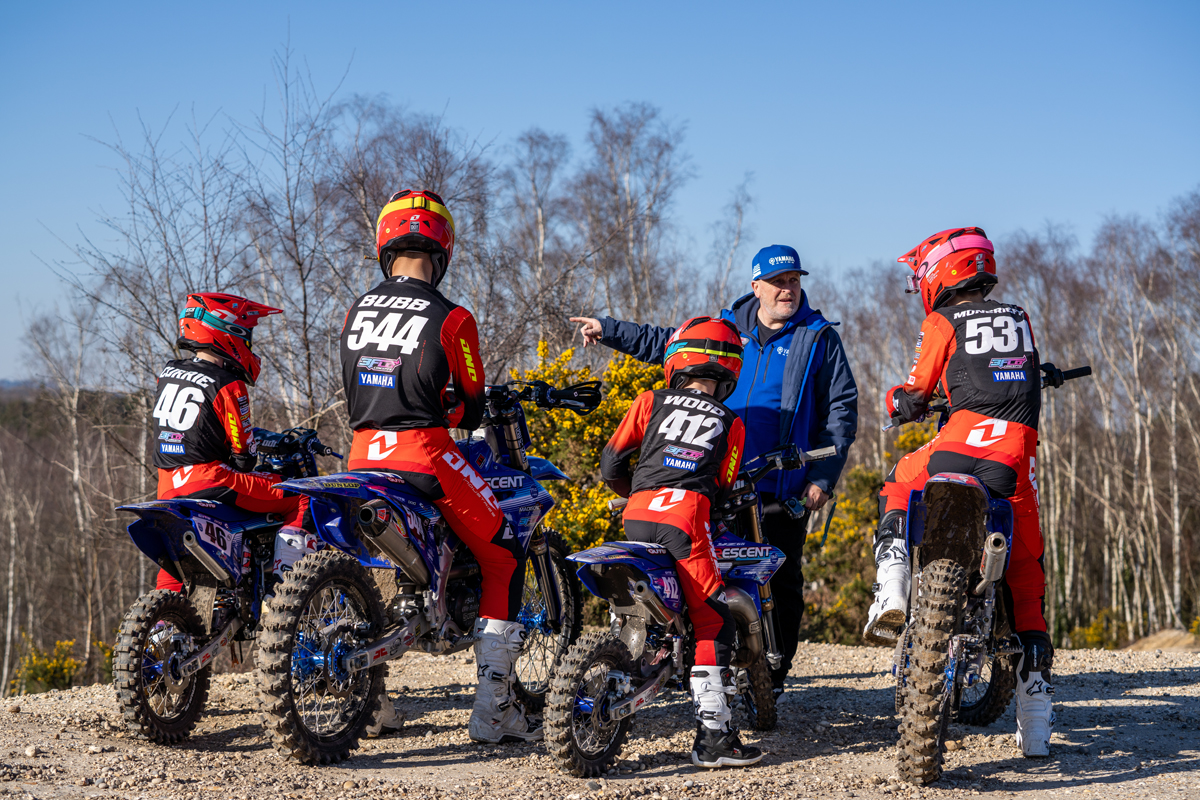
Right now, I’m putting all my focus into the Blu Cru program, my 3 Flo team and helping my friend Julie Coyne with the EXGB Balance Bike racing events and enjoying that and seeing new kids and parents coming into our sport. I’ve just started a new 3 Flo academy team, so effectively, I’ve got two 3 Flo teams now, we’ve got the official Yamaha Uk backed team, which is the 3 Flo Madison Crescent team, and now the new 3 Flo Ninju academy team. I’ve got another six riders on that, so I’m looking after 11 youth riders this year and will be coaching them. Right now I’m busy between Arenacross sorting out all the products from our awesome team partners, all the clothing and hardware products for our team photoshoot and the season ahead, going through all the Blu Cru applications as we get close to registration closing and sorting media and marketing with our partners at EXGB ready for the first round of the championship at Wheeldon in Devon on February 28th.
Hopefully I will get invited back to do the World Supercross later this year. I haven’t signed a multi-year contract or anything with them. I’ll be presenting the live stream for the British Motocross championship again this year with Phil Gee and I’ll be doing the live commentary at the British GP and Vets MXDN with Roger Warren again and a few other commentary gigs like the Masterkids. My year is pretty stacked out, I only have four weekends off from the end of February through to the Weston Beach Race, and that’s not including the World Supercross if I get asked to do that again. It’s full on, but it’s the life I’ve chosen to lead. I wouldn’t do it if I didn’t enjoy it.
GateDrop: Just a question on the GP’s, I always thought you and Malin, you’ve done it with him a few times, I always thought you two were the dream team together. It will probably never happen but if Infront gave you a call to do them, would that be something you’d be looking to do?
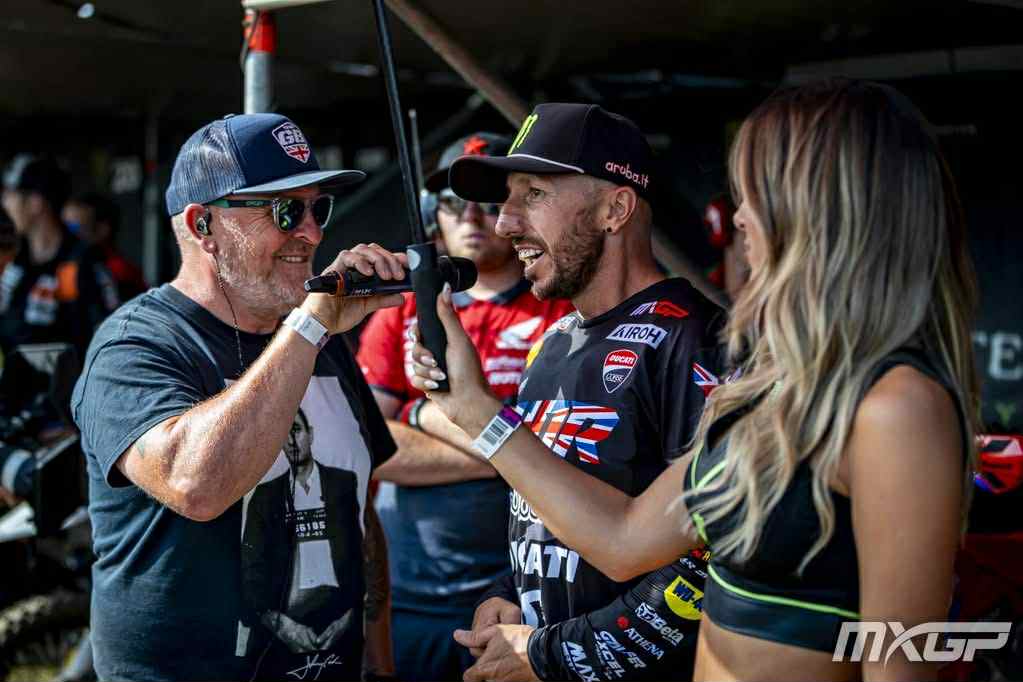
Perrett: Of course I’d consider that, but I don’t think that would ever happen. Paul does an amazing job on his own, and he’ll probably play that down, but he really does and I’m busy with a lot of other jobs and projects. I think until you’ve done it, until you’ve actually done event commentary you don’t appreciate how mentally taxing it can be. I don’t want to talk to anyone on the way home after an event as my throat is sore and my head still buzzing. There’s a lot of people I’m sure who think it’s easy and some think they could do a better job, maybe they could, so they should give it a go and start at a regional event. People will always pull you up on your mistakes and we all make mistakes sometimes, that’s only human nature. We’re not robots, we’re human and you’ve got hundreds of names and numbers going round your head as well as all that other information that people want to hear. That’s just how it is, because sometimes you’re looking at the timing TV screen, you’re looking at notes, sometimes you have a director in your ear, you just inevitably make mistakes but the real mistake would be to not be full engrossed into it and passionate and just going through the motions of treating it like a job I think.
The enthusiasm and level of professionalism that Paul brings to it is obvious. When you’re doing it with two of you, it’s always easier, you can bounce off each other, you get that little bit of a break, get some breaths in, a quick gulp on a drink and just compose yourself. When you’ve got to go all day, which he does, as a one man show, he does an amazing job. I think primarily Paul has obviously got a talent for it, he’s a good talker, he always has been and people have said the same about me, but it has to stem from a desire. If you really love what you do, it just comes out, and that goes for anything, whatever you do. Every time I’ve jumped in the booth with Maler, it’s been a pleasure and I’ve enjoyed running through the action with him. We’re both passionate, we’re both ex-racers and I think sometimes that gives you a bit more ammo to fire out. Roger Warren has said that to me quite a few times, he has a brilliant voice for commentary that comes naturally and I really enjoy working with him but like Roger says in his own words, he’s never raced motocross at a high level. He picks up on that I’m probably seeing stuff that he can’t really relate to because he’s never ridden at that level and he always encourages me to comment on it. I think if you’re an ex-rider of a certain level you see more. I can usually tell if somebody’s found a good new line or is setting someone up for a pass in a certain place because of all those years of racing at a high level and having a better under standing of race strategy. Our sport is one of the most exciting and physically and mentally challenging in the world, there’s always so much going on in any one race. I find it a pleasure to talk about and to be about it. It’s my life, it’s what I do, it’s shaped who I am and I love it. I’m looking forward to another busy year ahead, calling a lot of action and seeing it all unfold. It’s epic, it’s the King of sports in my opinion.