





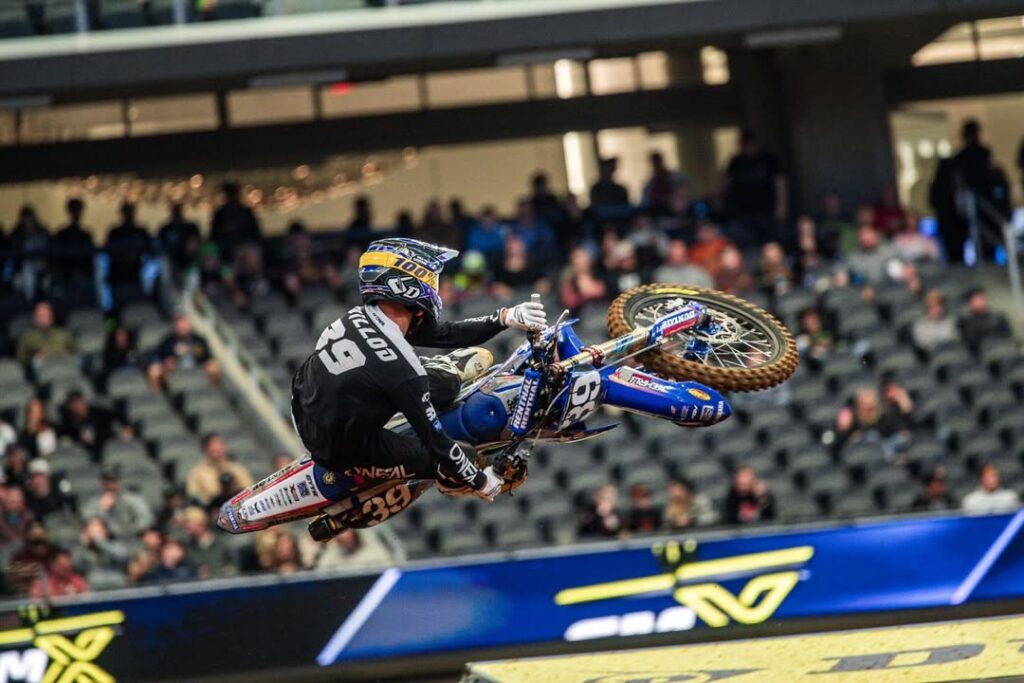
It was the first appearance in the AMA Supercross series and the first reality check. Valentin Guillod made his debut in the discipline on Saturday in Arlington, at the opening round of the championship on the East Coast. But for the Swiss rider, the day quickly turned into a headache, with a crash in the very first laps of practice marking the beginning of a series of problems. Bitter but honest, the Gizmo Racing Yamaha rider reflected on Arlington with Kevin Frelaud.
“I went down in a corner on the second lap of the first practice session. I got caught out by the grip, it was very—very slippery. The bike never started again,” Guillod explains. “So I missed the first session, I had only done two laps, I hadn’t even been able to go through all the rhythm sections. Luckily, I had done the press day on Friday and was able to dial in one or two parts of the track. I was 39th after that first session. In the second session, I had to put in a good lap without taking too many risks because I still needed to secure something. I did a few laps, I felt good, but the lap times weren’t dropping. That’s also when I realized I was struggling to do the rhythm sections with the bike, I was lacking torque, power. I was 34th in qualifying. When I saw that, I was really not happy. We had to make changes to the bike before the qualifying heat, to find power, to be able to send the triple before the whoops for example.”
With his back against the wall after frustrating qualifying sessions, Guillod was aiming to turn things around in his heat race. Lining up 16th on the gate and positioned on the outside, the Swiss rider was battling for a spot in the main event while running just outside the top ten early in the race.
“I came into the heat race with new parts on the bike, to try to make up for that lack of torque,” continues the Gizmo Racing rider. “I ended up on the outside on the gate. I got off the line quite well, but I got boxed in straight away. I must have been 17th. I squeezed through and moved up to 11th behind 9th and 10th. I thought there was a chance to qualify, I felt good. We were the first ones on track, they had watered the track in the afternoon and I lost the front in a rhythm section. I messed up, jumped onto the hay bales and went off the track. I lost three places, I was 14th and it was over for me.”
Last chance to secure a place in the main event, last card to play: the LCQ. But after being hit by another rider at the end of the first rhythm section in the LCQ, the Swiss rider’s night came to an end there. A Texas experience to leave behind.
“For the LCQ, I put everything on the start. I lined up on the inside of the hut, I focused on getting a good start, triggering it well. I came out of the gate really well, but after 10 meters, the guys boxed me in again. I was 7th or 8th and at the end of the first rhythm section, the guy behind me did a different sequence; he jumped on me and landed on my right hand. I took a big hit, lost balance and crashed in the next corner. That was it. I went back to the truck, pretty much at rock bottom.”
“The hand isn’t broken,” Guillod reassures. “Maybe I was lucky, because where the impact was on my hand, I have a plate since I had already broken it back in 2017. That might have saved me from a fracture. But I also fell on the shoulder that was injured last year. Whenever I land on that right shoulder, my muscles hurt every time. Now, two days later, it still hurts.”
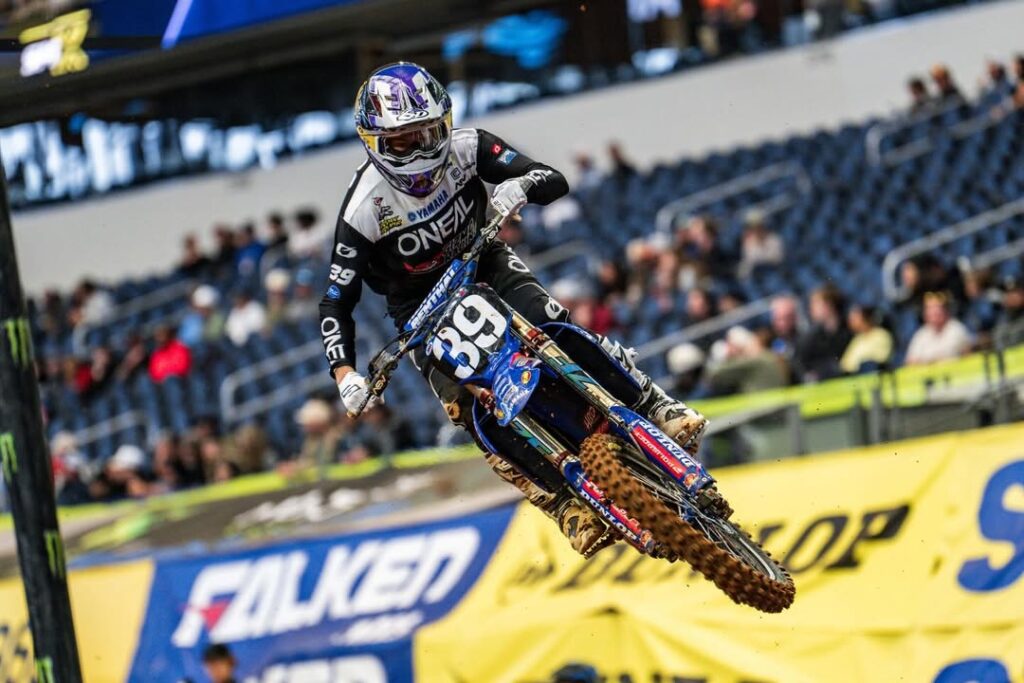
Looking back at his first American experience, Guillod realizes some mistakes were made, but also understands the harsh reality of US Supercross. The Arlington weekend was bitter, yes, but full of lessons. Another opportunity to bounce back is already on the horizon, with the Daytona round this Saturday.
“In the end, everything was new for me. There were technical problems, we realized the lack of power. I was obviously tense because it’s an incredible experience. It was new, there was a lot of stress. I wasn’t at 100%, maybe 80%, 90%. That’s the emotional side.”
“Thinking back, I had said that I wanted to train alone during the winter, to really focus on myself, focus on the timing of the rhythm sections, so as not to go faster than the music. If you go faster than the music in Supercross, you end up in the hospital, and that’s really what I want to avoid. I had said that maybe I wasn’t taking the right direction, that maybe I was making a mistake and that maybe it would need to be done differently. But I had chosen that path.”
“It was everything combined. I missed a practice session and therefore 12 minutes. During that time, the others do 12 more laps than you and are more comfortable on the track. I hadn’t been able to adapt the bike after the first session, so I was behind there too. I was behind the whole time. On top of that, I had no experience compared to the others. It was the first time I rode on a track with jumps that big and technical. That’s the issue I see with my training. For me, the training tracks are too easy, but that’s to avoid riders getting injured. Before Saturday, I had never ridden a Supercross track that slippery.”
“The summary is that I’m really disappointed, angry as well. I didn’t train like this to finish 33rd in qualifying. I hadn’t even imagined once not qualifying for the main event. I had considered going through the LCQ, but not qualifying? No.”
Despite the disappointment, Guillod prefers to focus on the positives, particularly his physical condition. Developments are expected on his 250 YZ-F before Daytona, and his training program should be adjusted in light of the lessons learned from this first Arlington experience.
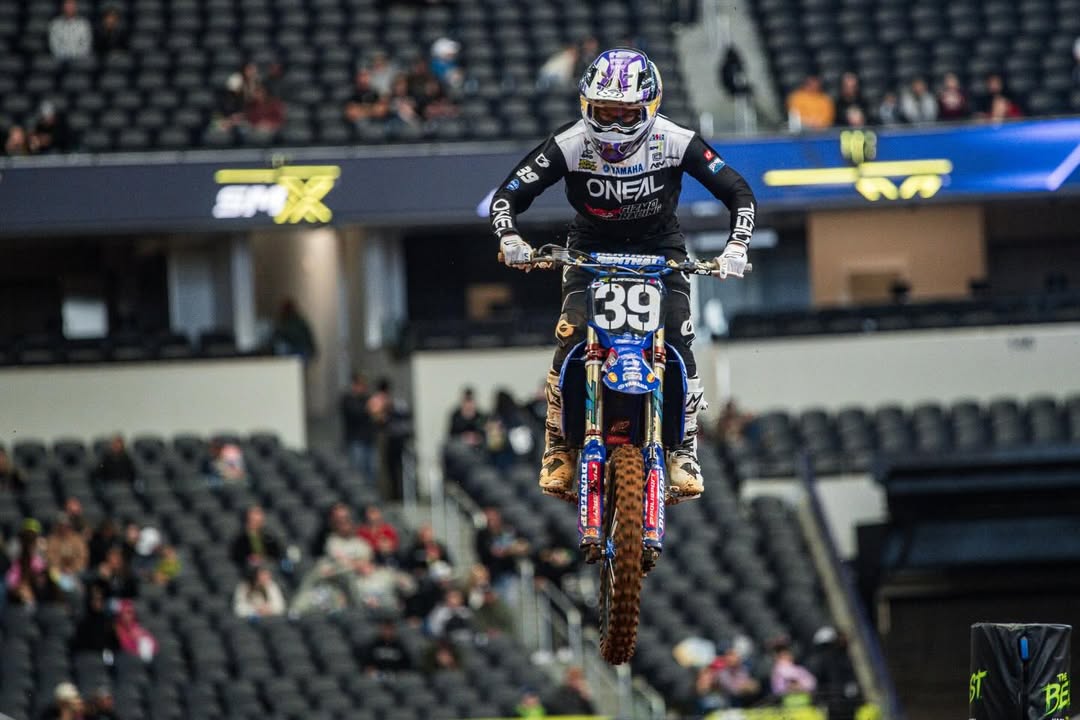
“The positive side is that when I finished the 8-minute heat race, physically I felt good. I took two breaths and I felt fine. I know I’ve done good physical work. I have a good base and on that side there’s no need to question anything. After that, I saw the speed of the guys. I saw the riding style you need in the races. Now I can reproduce that in training by setting lap times, doing small motos of 3–5 laps, trying to be clean. I’ll have to adapt quickly, find the right rhythm and keep the speed. These are things I can now put in place and work on in training.”
“I also saw the intensity they bring, I felt that intensity. I now know what kind of pace I need to look for when I’m training,” concludes Guillod. “That’s the part I can change and adapt in my program. We have a meeting this week with the team so we can find solutions to get much more torque on the bike, so I can turn more quickly in the ruts, have a bit more speed and be able to send the triples out of corners. The goal is to have a new engine and new updates by Wednesday. We’ll see the difference and try to validate that part.”